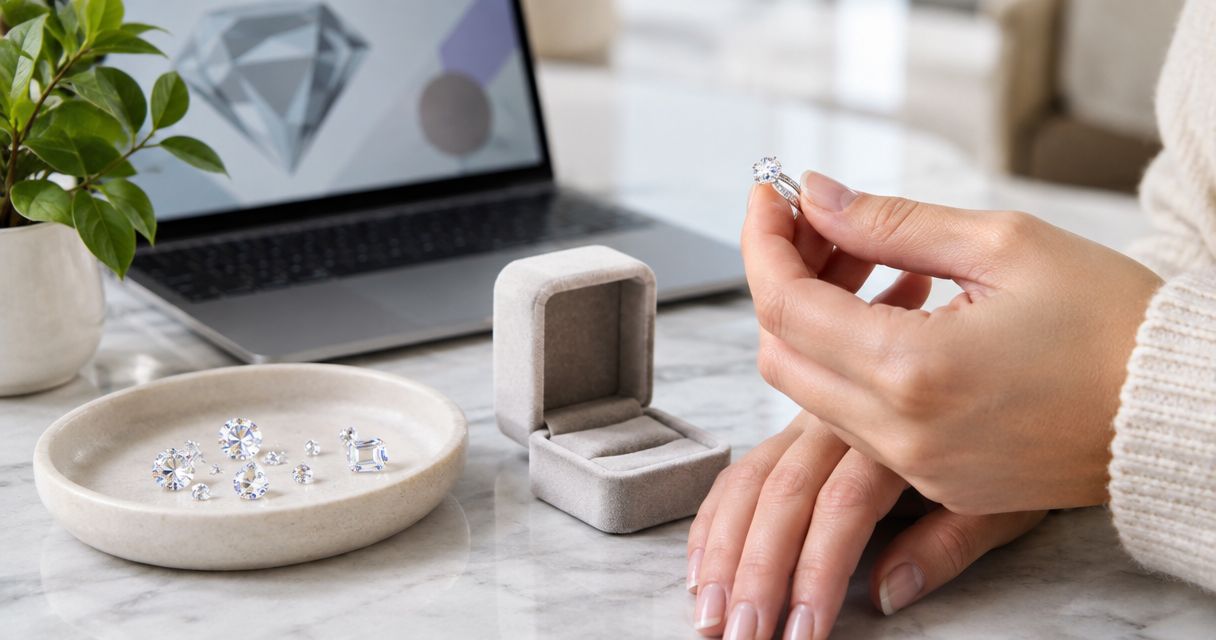
Lab-grown diamond jewellery is worth it in 2026 if you want more carat weight and cleaner clarity for the same setting budget, and you're buying to wear rather than to resell. The trade-off is resale value: lab-grown stones lose value faster on the secondary market than natural, IGI-certified diamonds of comparable grade. For everyday pieces and gifting, that trade-off rarely matters; for a stone meant to be passed down or resold decades later, it does.
- Is lab grown diamond jewellery worth it in 2026? Yes for wear and gifting, not for resale value.
- IGI-certified lab-grown diamonds match natural stones in hardness, brilliance and 4Cs grading.
- Resale value is the real weak point — lab-grown stones depreciate faster than natural diamonds.
- Auram Jewellery sets lab-grown diamonds in BIS hallmarked 916 gold with the same karigar craftsmanship used for natural stones.
Why this matters
Lab-grown diamonds sit in nearly every Indian jeweller's case in 2026, next to natural stones, at the same counters. That proximity is exactly why buyers get confused: the two look identical to the naked eye, and both can carry a genuine IGI certificate, so the difference between them isn't visible — it's chemical origin and long-term value.
The honest way to think about it: a lab-grown diamond is a real diamond, grown in a lab instead of the earth, with identical carbon crystal structure. What changes is scarcity, and scarcity is what drives resale price on any diamond, natural or lab-grown. If you're buying lab-grown diamond earrings for daily wear or a gift, that scarcity discount barely matters. If you're buying a solitaire you expect to sell back in 2040, it matters a lot.
Is lab-grown diamond jewellery worth it in 2026?
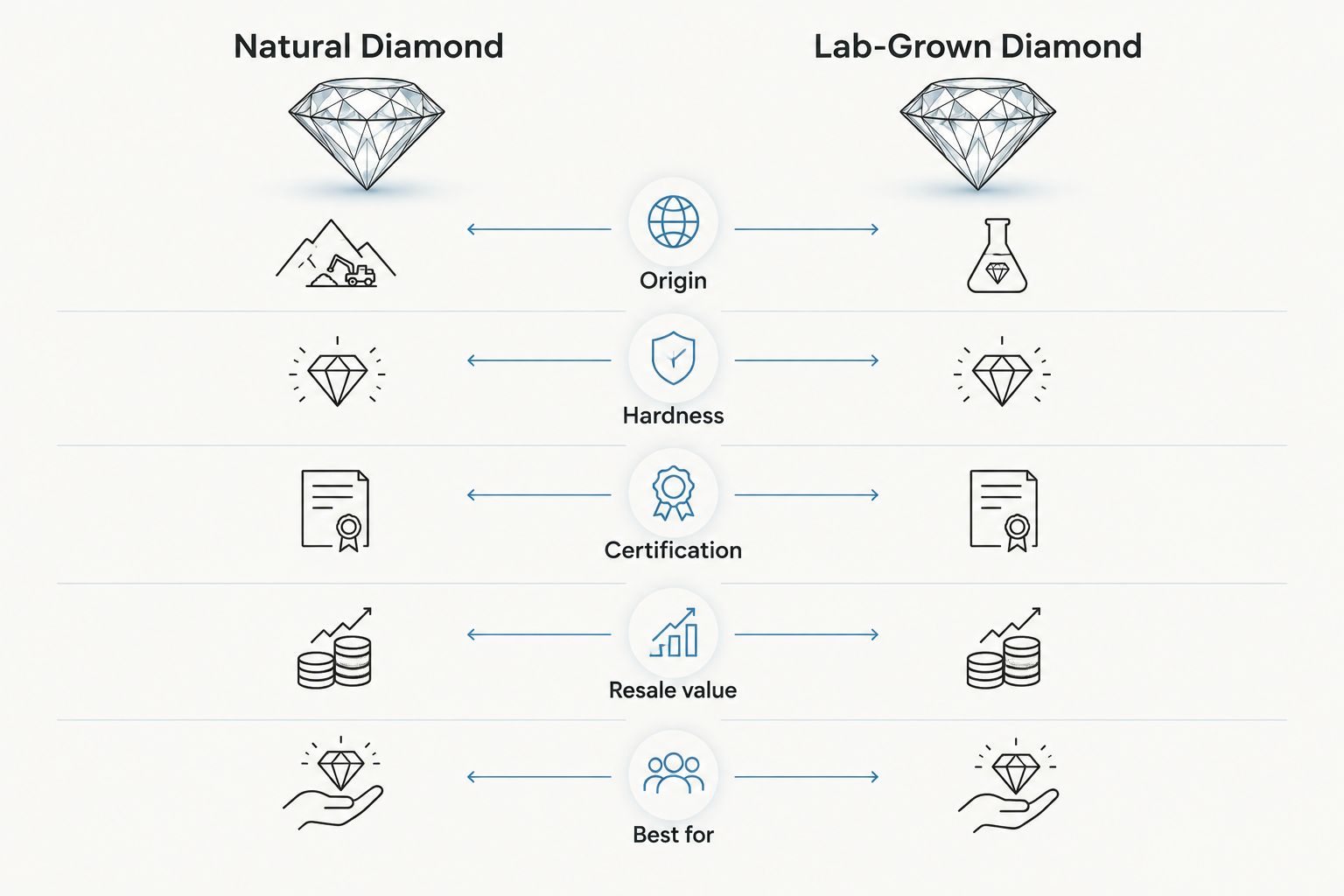
The short answer depends on what you're optimizing for — size and budget, or heirloom value and resale. Here's the comparison that actually decides it:
| Attribute | Natural Diamond | Lab-Grown Diamond |
|---|---|---|
| Origin | Formed underground over billions of years | Grown in a lab over weeks to months |
| Hardness | 10 on the Mohs scale | 10 on the Mohs scale (identical) |
| Certification | IGI, GIA and similar labs grade both types | IGI grades lab-grown with the same 4Cs |
| Visual difference | None visible to the naked eye | None visible to the naked eye |
| Resale value | Holds value better over decades | Depreciates faster on resale |
| Environmental footprint | Mining-linked, varies by source | Lower land disturbance, energy-linked |
| Best for | Heirlooms, engagement rings meant to be resold | Everyday wear, fashion pieces, gifting |
The hardness is identical because it's the same mineral, carbon, arranged the same way — that's not marketing, it's physics. The only column that consistently favors natural diamonds is resale, and that's the column to weigh honestly before you commit.
Where lab-grown diamonds win in 2026
Lab-grown stones make the most sense when the diamond is meant to be worn, not banked. A bigger, cleaner stone for the same setting budget is the real advantage, not a marketing line.
- Everyday and fashion jewellery — studs, pendants, and stackable rings you'll wear weekly, where wear-and-tear matters more than resale.
- Gifting occasions — birthdays, anniversaries, and festive gifts where the recipient values the look and the certificate, not future resale.
- Larger carat pieces on a fixed budget — you get more visible size per rupee spent on the stone itself.
- Buyers who want size over rarity — if brilliance and carat weight matter more to you than provenance.
Where natural diamonds still win
Natural, IGI-certified diamonds still make more sense for a narrower set of purchases, mostly tied to permanence and resale.
- Engagement rings meant to be resold or upgraded later — check diamond engagement ring designs where resale planning matters.
- Heirloom pieces passed down across generations — natural stones carry provenance value that compounds with age.
- Investment-minded purchases — if part of the purchase logic is store-of-value, natural diamonds hold that role better.
- Buyers prioritizing rarity as part of the meaning of the gift — some buyers want the stone's age and origin story, not just the look.
Why lab-grown diamond value varies
Not every lab-grown diamond is priced or made the same way, and the variation isn't random. These are the factors that actually move value:
- Carat weight — larger stones cost more per carat even within lab-grown, following the same curve as natural diamonds.
- Cut precision — a poorly cut lab-grown stone loses brilliance regardless of how clean the clarity grade reads on paper.
- Certifying lab — an IGI report on a lab-grown stone carries more buyer confidence than an uncertified or lesser-known lab's grading.
- Gold purity of the setting — a stone set in BIS hallmarked 916 or 22KT gold carries more resale weight in the setting than one set in lower-purity alloy.
- Color and clarity grade — the 4Cs apply identically to lab-grown stones; a D-color, VVS1 lab-grown diamond still outranks a J-color, SI2 one.
- Craftsmanship of the setting — hand-finished work by karigars holds its shape and prong security longer than mass-produced factory settings.
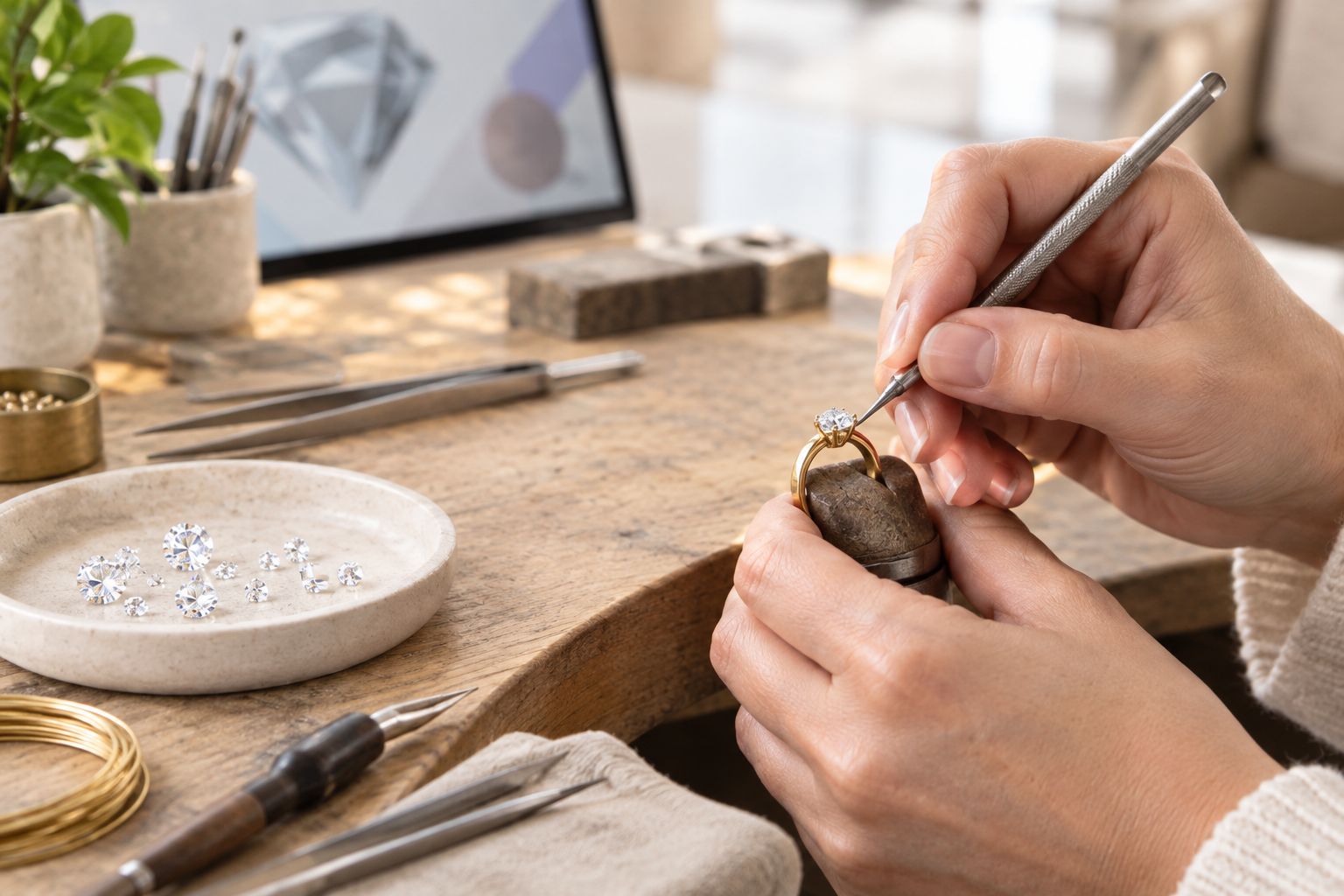
At Auram Jewellery, lab-grown diamonds are set the same way natural stones are — by hand, by third-generation karigars, in BIS hallmarked gold. No factory lines, only artisans, for both stone types.
Do lab-grown diamonds hold their resale value?
Lab-grown diamonds hold less resale value than natural diamonds of the same grade, and that gap has been the consistent pattern since lab-grown supply scaled up. The resale market still prices scarcity, and lab-grown stones are, by design, not scarce. If resale is part of your buying decision, factor this in before you commit to carat size over stone origin.
Can jewellers tell lab-grown diamonds apart from natural ones?
Jewellers cannot reliably tell lab-grown diamonds from natural ones by eye — both are chemically identical carbon crystals with the same brilliance and hardness. Distinguishing them requires specialized lab equipment that detects growth-pattern differences invisible to a loupe. This is exactly why a certificate, not a visual inspection, is the only reliable way to know what you're buying.
Is IGI certification necessary for lab-grown diamonds?
IGI certification is necessary for any lab-grown diamond purchase because it's the only document that confirms origin, carat, cut, color and clarity in writing. Before paying for a lab-grown stone, checking your diamond's IGI certificate number against the report takes a few minutes and confirms the stone matches what's on paper. Skip this step and you have no way to verify the grading claims later.
Talk through your diamond options
Book a video consultation before you commit to a stone or setting.
FAQ
Are lab-grown diamonds real diamonds?
Yes, lab-grown diamonds are real diamonds with the same carbon crystal structure, hardness and optical properties as natural stones. The only difference is where they formed — a lab instead of underground over geological time.
Is lab-grown diamond jewellery a good investment in 2026?
Lab-grown diamond jewellery is not a strong investment in 2026 because resale value depreciates faster than natural diamonds. Buy it for wear and gifting, not as a store of value.
Does BIS hallmarking apply to jewellery with lab-grown diamonds?
BIS hallmarking applies to the gold setting, not the diamond itself, so a lab-grown diamond ring in 916 or 22KT gold still needs a valid hallmark. The diamond's authenticity is verified separately through its IGI certificate.
What's the difference between lab-grown diamonds and moissanite?
Lab-grown diamonds are chemically identical to natural diamonds, while moissanite is a different mineral, silicon carbide, with different hardness and brilliance. The two are graded and certified differently, and only diamonds carry a Mohs hardness of 10.
Should you choose lab-grown diamonds for an engagement ring?
Choose lab-grown diamonds for an engagement ring if size and clarity matter more to you than resale value and provenance. Choose natural diamonds if you expect to resell or pass the ring down as an heirloom.
Can lab-grown diamonds turn cloudy or lose brilliance over time?
No, lab-grown diamonds do not lose brilliance over time because their hardness and structure are identical to natural diamonds, both rated 10 on the Mohs scale. Cloudiness in any diamond setting usually comes from dirt buildup, not the stone degrading.
Is a lower price the only reason to choose lab-grown diamonds?
No, lower relative cost per carat is one reason, but larger visible size for the same setting budget and identical certification are equally common reasons buyers choose lab-grown diamonds in 2026.
One last thing
The detail most buyers miss: a lab-grown diamond's IGI certificate looks almost identical to a natural diamond's certificate, except for one line stating the origin as "laboratory-grown." Read that line before you pay, not after — it's the single fact that separates the two purchases, since nothing else on the report or the stone itself will tell you.