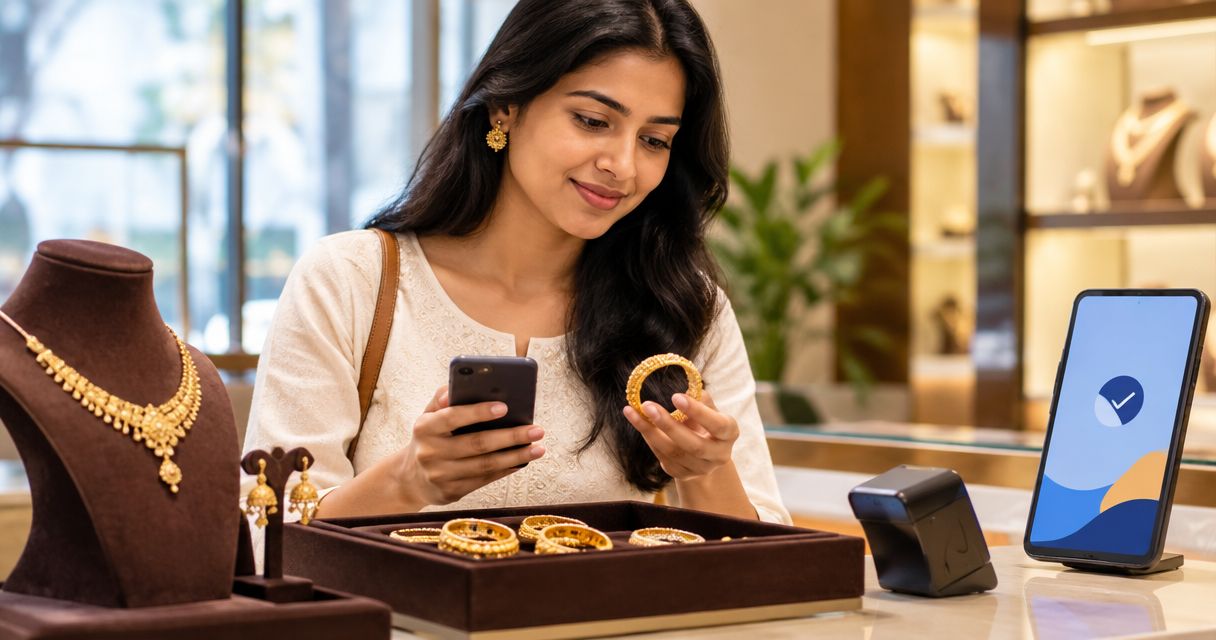
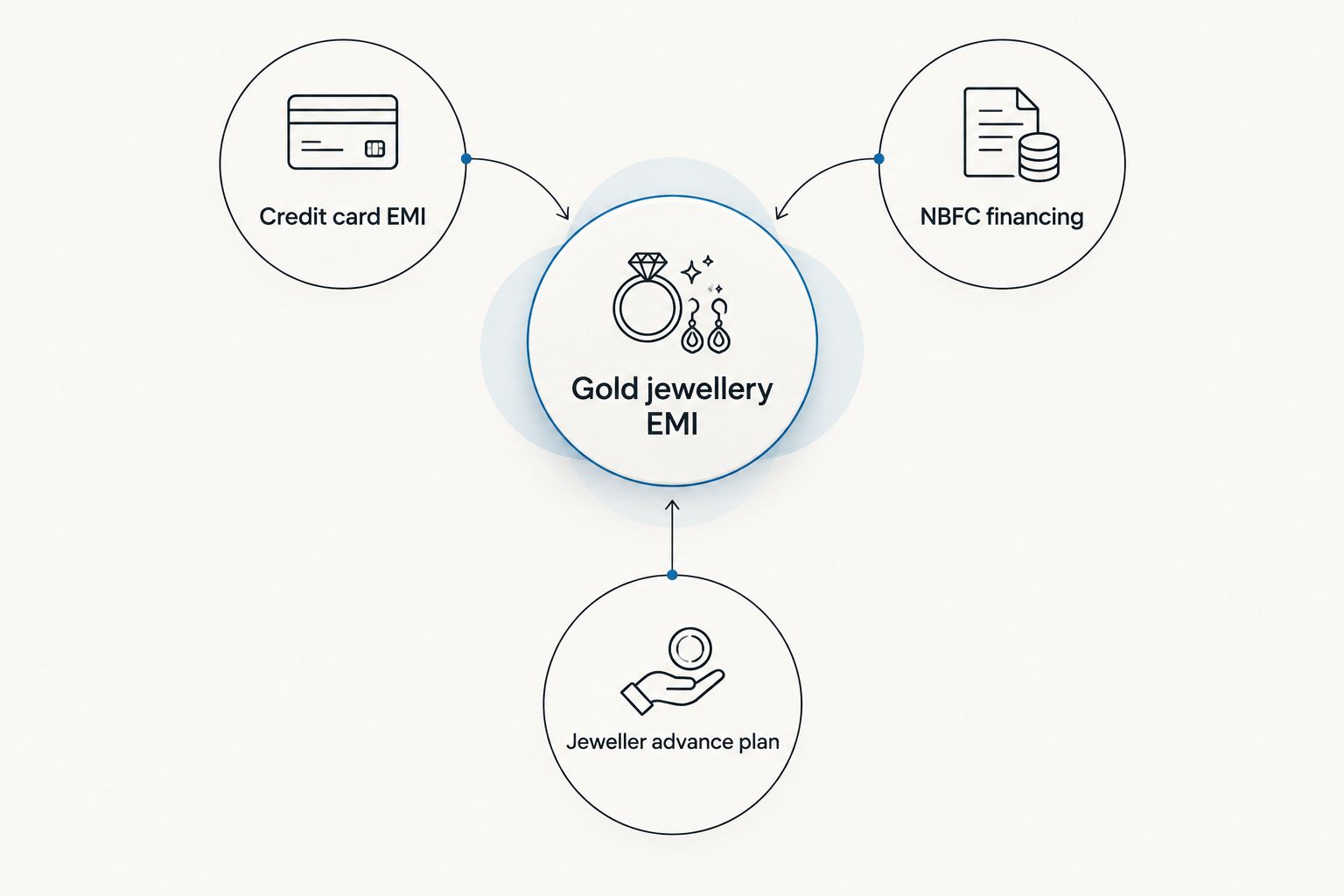
Yes, gold jewellery can be bought on EMI in India in 2026, through a credit card's no-cost EMI facility, an NBFC or financing-partner loan, or a jeweller's own advance-payment plan for a bridal set. The catch buyers miss: a "no-cost" EMI usually folds the interest into the item price instead of removing it, and GST lands on the invoice separately no matter which route you pick.
- Gold jewellery on EMI works through credit card no-cost EMI, NBFC financing, or a jeweller's own advance-payment plan in 2026.
- No-cost EMI typically hides the interest cost inside the item price rather than removing it.
- GST is billed on top of the EMI amount regardless of the payment route chosen.
- Auram Jewellery documents its own EMI-to-delivery payment workflow for gold and bridal buyers.
- BIS hallmarking and IGI certification don't change with the payment method - verify both before you pay.
Why this matters
A bridal gold set or a heavy choker is rarely an impulse buy - it's often the single biggest purchase a family makes that year. Spreading that cost across a few months instead of paying it upfront changes whether a family buys the set they actually want or settles for something lighter.
Auram Jewellery, the Kolkata-based jeweller behind handcrafted, BIS hallmarked gold and IGI-certified diamond pieces, lays out its own payment sequence in its EMI approval to delivery workflow, which is worth reading before you commit to a route. The mechanics below apply broadly across Indian jewellers in 2026, not to any single retailer.
Can you buy gold jewellery on EMI in India?
The short answer is yes, and there are three practical routes. Each one changes who approves the credit, what gets covered, and how fast the piece ships.
| Route | What it covers | Best for | Verdict |
|---|---|---|---|
| Credit card no-cost EMI | Gold value and making charges within your card limit | Buyers with an existing card and enough headroom | Buy if your limit covers the full invoice |
| NBFC or financing-partner loan | Full invoice as a separate consumer loan | Buyers without card capacity for a big-ticket set | Hold - compare processing fees first |
| Jeweller's own advance-payment plan | Staggered payments agreed before delivery | Bridal buyers ordering months ahead | Buy for a wedding date you've already fixed |
Making charges deserve a separate look before you lock any EMI plan, since they shift the total the plan needs to cover - see the breakdown in making charges on gold jewellery.
Credit card no-cost EMI
This is the fastest route at checkout: swipe, pick a tenure the bank offers, and the invoice converts into monthly instalments. The bank, not the jeweller, decides your eligibility and tenure options.
The trade-off is the price itself. Banks and retailers have long built the "waived" interest into the marked price rather than genuinely absorbing it, which is why the same piece can look cheaper if you simply pay the full amount upfront. Compare the EMI total against the one-time price before you swipe.
NBFC and financing-partner EMI
When a set is too large for a card limit, an NBFC or consumer-finance partner steps in with a dedicated loan against the jewellery invoice. Approval runs on your income and credit profile rather than an existing card relationship.
This route usually means a processing fee and a formal loan agreement, so read the fee line before signing. It suits bridal buyers financing a full set - bangles, necklace, and earrings together - where the invoice exceeds typical card limits.
Jeweller's own advance-payment plan
Some jewellers let a buyer pay in stages ahead of a fixed delivery date, particularly for a bespoke or made-to-order bridal commission. This isn't a bank EMI - it's an agreement between buyer and jeweller with no third-party interest calculation involved.
It fits weddings booked well in advance, where the design, stone-setting, and hallmarking checks all need lead time anyway. Confirm in writing what happens to the advance if the wedding date shifts or the order is cancelled.
Why EMI cost varies
The total you actually pay on any EMI route depends on a handful of factors, not the payment method alone:
- Card issuer and bank policy - tenure options and eligibility differ bank to bank
- Item value - a plain gold band and a diamond-studded set carry very different EMI bases
- Diamond certification - an IGI-certified stone adds documented value that the EMI principal reflects
- Hallmarking compliance - a BIS hallmarking mandatory piece carries verified purity, which is what the EMI amount is actually financing
- Making charges - karigar-crafted, non-factory pieces price making charges differently than machine-made stock
- Advance-plan terms - a jeweller's own staggered plan has no bank-set tenure grid, so terms are negotiated case by case
Does EMI cover making charges and GST on gold jewellery?
EMI on gold jewellery typically covers the gold value and making charges together as one financed amount, but GST is calculated and displayed separately on the invoice. GST applies at 3% on the jewellery value in the standard structure, and that tax line doesn't move whether you pay upfront or on EMI.
Can you buy gold jewellery on EMI without a credit card?
You can buy gold jewellery on EMI without a credit card through an NBFC or financing-partner loan, or through a jeweller's own advance-payment plan. Both routes assess you directly rather than through an existing card limit, so approval timelines differ from instant card-based EMI.
Is buying jewellery on EMI a good idea before a wedding?
Buying jewellery on EMI before a wedding works well when the delivery date and the EMI tenure both fit comfortably inside your planning window. Lock the design, hallmarking, and certification checks early, since resizing or reworking a piece after EMI approval adds delay you don't want close to the date.
See the EMI-to-delivery workflow
Understand approval, dispatch, and hallmark checks before you commit to a plan.
FAQ
What is no-cost EMI on gold jewellery?
No-cost EMI splits the invoice into monthly instalments with no separate interest line charged to you, but the cost is usually built into the item's marked price. Compare the EMI total to the one-time cash price before choosing it.
Can you buy gold jewellery on EMI without a credit card?
Yes, an NBFC or financing-partner loan and a jeweller's own advance-payment plan both work without a credit card. Approval depends on your income and credit profile instead of an existing card limit.
Does EMI cover making charges and GST on gold jewellery?
EMI typically finances the gold value plus making charges together, while GST is billed separately on the invoice. The standard GST rate on gold jewellery value is 3% in 2026, regardless of payment method.
Is buying gold jewellery on EMI a good idea in 2026?
It's a good idea when the EMI total, once you compare it to the upfront price, doesn't exceed what you'd pay in cash by more than the convenience is worth. It works best for planned purchases like a bridal set with a fixed wedding date.
Do NRIs get gold jewellery EMI in India?
NRI buyers generally need an India-issued credit card or an NBFC loan tied to an Indian credit profile to access EMI, since most financing partners require domestic income or credit history. A jeweller's advance-payment plan is often the more workable route for NRI bridal orders.
Can you foreclose or prepay a gold jewellery EMI?
Most credit card and NBFC EMI plans allow foreclosure, though foreclosure charges depend on the bank or financing partner's own policy. Check the foreclosure terms before signing, since they aren't standardised across lenders.
Does BIS hallmarking or IGI certification change on EMI purchases?
No, hallmarking and certification requirements are identical whether you pay upfront or on EMI. A BIS hallmarked gold piece and an IGI-certified diamond carry the same verification either way.
What documents are needed to buy gold jewellery on EMI?
Credit card EMI needs only the card itself at checkout, while NBFC financing usually asks for income proof and ID verification. A jeweller's advance-payment plan is typically documented as a written order agreement rather than a loan application.
One last thing
Lock the hallmarking and certification checks before the EMI paperwork, not after. Once a bank or NBFC approves an EMI against a specific invoice, resizing a ring or reworking a stone setting means amending that approved amount - a step most lenders make slower than the original approval itself.