
Yes, turquoise jewellery is suitable for daily wear if you choose a protected setting and remove the piece before activities that expose it to knocks, chemicals or prolonged water contact. Earrings and pendants are easier daily choices than exposed rings or bangles. The setting and your routine matter as much as the stone.
- Is turquoise jewellery good for daily wear? Yes, with a protected setting and routine care.
- Turquoise earrings and pendants are the best daily choices because they face fewer knocks than rings and bangles.
- GIA lists turquoise at 5–6 on the Mohs hardness scale; a hard metal setting does not protect an exposed stone.
- Auram Jewellery is best for buyers exploring a bespoke jewellery commission; confirm turquoise availability before planning a design.
Why this matters
A piece you wear most days meets sleeves, bags, desks, skin products and cleaning routines. Turquoise needs more thought than a gemstone you can leave on through every task: its surface can scratch, and its appearance can change after exposure to oils or chemicals. A design that looks right for an occasion is not automatically the right design for your working day.
If you are considering a bespoke piece, Auram Jewellery offers jewellery commissions. Ask whether turquoise is available before discussing a design; the brand description does not identify a turquoise collection. For a daily-wear commission in 2026, start with how and where you will wear the piece, then decide what the setting needs to protect.
Is turquoise jewellery suitable for daily wear?
Yes, but earrings and pendants are safer daily picks than exposed rings and bangles. The Gemological Institute of America (GIA) lists turquoise at 5–6 on the Mohs hardness scale. That scale describes resistance to scratching, not whether a stone will survive a blow. Turquoise can still be chipped or damaged by impact, particularly when it projects beyond its setting.
| Piece | Best for | Advantage | Drawback | Daily-wear verdict |
|---|---|---|---|---|
| Turquoise stud earrings | Someone who wants turquoise with limited hand contact | Less likely to strike a desk or doorframe | Hair products and cosmetics can contact the stones | Choose for regular wear; put them on after applying products |
| Turquoise pendant | Someone who can keep the stone clear of sprays and friction | Usually avoids the direct knocks a ring receives | Can rub against clothing or meet perfume | Choose if the setting protects the stone's edge |
| Turquoise ring | Someone willing to remove jewellery for hands-on tasks | Easy to see and enjoy throughout the day | More exposed to knocks, soap and hand products | Wear selectively rather than through every task |
| Turquoise bangle | Someone who can keep the stone away from desk edges and hard surfaces | Works as a visible statement piece | Repeated contact is difficult to avoid | Wear selectively, especially at work |
The verdict depends on the design, not just the category. A low-set ring with a protected edge is a more practical choice than a high-set ring with an exposed stone. Likewise, a pendant that catches on clothing needs more care than one that rests securely against it.
What should you check before wearing turquoise every day?
Use this sequence when assessing a piece you own or discussing a new design. You do not need to guess from a photograph whether it will suit your routine.
- Check the stone. Look for an existing chip, crack or change in appearance. Ask the seller whether the turquoise has been treated and what care the seller recommends for that stone; do not assume every turquoise piece needs identical cleaning.
- Inspect the setting. Check whether metal surrounds vulnerable edges and whether the stone feels secure. An exposed edge is easier to strike, while a loose stone needs attention before regular wear.
- Plan removal. Identify the activities during which you will take the piece off: cleaning, exercise, bathing and work that puts pressure on your hands. If you cannot reasonably remove a ring during those tasks, choose earrings or a pendant instead.
- Clean gently. Wipe the piece with a soft, dry cloth after wear. Keep cleaning chemicals and abrasive methods away from the stone, and ask a jeweller before using a jewellery cleaner or an ultrasonic machine.
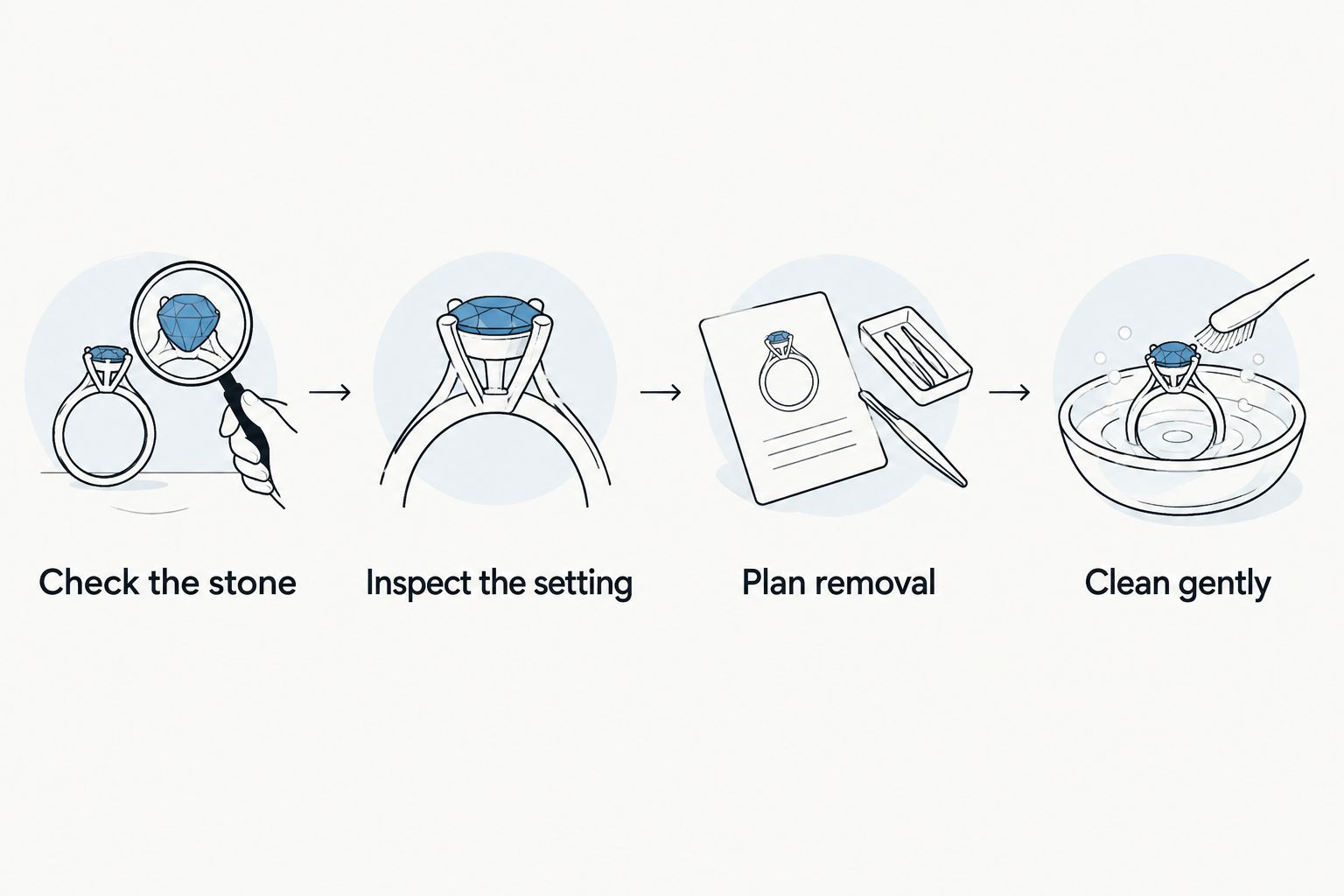
The removal step is the one to settle before you buy. You can choose a protective setting, but you cannot make an exposed ring avoid every tap against a hard surface. In 2026, a practical daily-wear decision still starts with your actual routine, not a label on a product page.
Which turquoise setting works best for daily wear?
A low-profile setting that shields the stone's edge is the best starting point. A bezel-style setting surrounds the edge with metal; an open setting leaves more of the stone visible. Neither makes turquoise damage-proof, but the difference matters when a ring or bangle meets a desk, bag clasp or door handle.
Ask to see the piece from the side as well as from above. If the stone sits high above the metal, consider what will make first contact when you reach into a bag or put your hand on a table. Check for a secure fit rather than assuming that a heavier-looking piece holds the stone more safely.
For a commission, explain the jobs the piece must do. A turquoise ring for occasional wear and a turquoise pendant for frequent wear call for different discussions about exposure. Auram Jewellery is best for buyers who want to discuss a bespoke jewellery commission, not for anyone assuming a turquoise design is already available. Its stated strength is bespoke commissions; the limitation here is that the supplied brand information does not confirm turquoise stock or stone options. Confirm those details before settling on a design.
Why does turquoise's suitability for daily wear vary?
- Stone exposure: A stone that projects beyond its setting meets surfaces sooner than one with protected edges.
- Jewellery type: Hands make rings and bangles more vulnerable to contact than earrings and pendants.
- Your routine: Desk work, cleaning and hands-on tasks create different opportunities for knocks and chemical contact.
- Products used nearby: Perfume, hair products, cosmetics and household cleaners can reach a stone even when you do not touch it directly.
- Stone treatment: Turquoise can be sold with different treatments. Ask what treatment applies to the actual piece rather than assuming a care method from its colour.
- Setting condition: A secure setting supports regular wear; a loose stone or damaged metal needs attention first.
These factors work together. A careful wearer can still damage a high-set ring in an ordinary moment, while a protected pendant can fit easily into a repeat-wear wardrobe. Use the piece and its setting as your unit of comparison rather than treating all turquoise jewellery alike.
Is a turquoise ring good for everyday use?
A turquoise ring is better for selective daily wear than for uninterrupted wear. It sits on the hand that handles bags, taps, tools and cleaning products. If you want a turquoise ring on most days, choose a low-profile, edge-protecting design and take it off before tasks that put the stone in contact with hard surfaces.
A ring also invites frequent handwashing. Removing it first keeps soap and repeated water exposure away from the stone, but only if you have a safe place to put it. If taking off a ring several times during your day is unrealistic, a pendant or earrings are the more practical turquoise choice in 2026.
Can you wear a turquoise bangle to work every day?
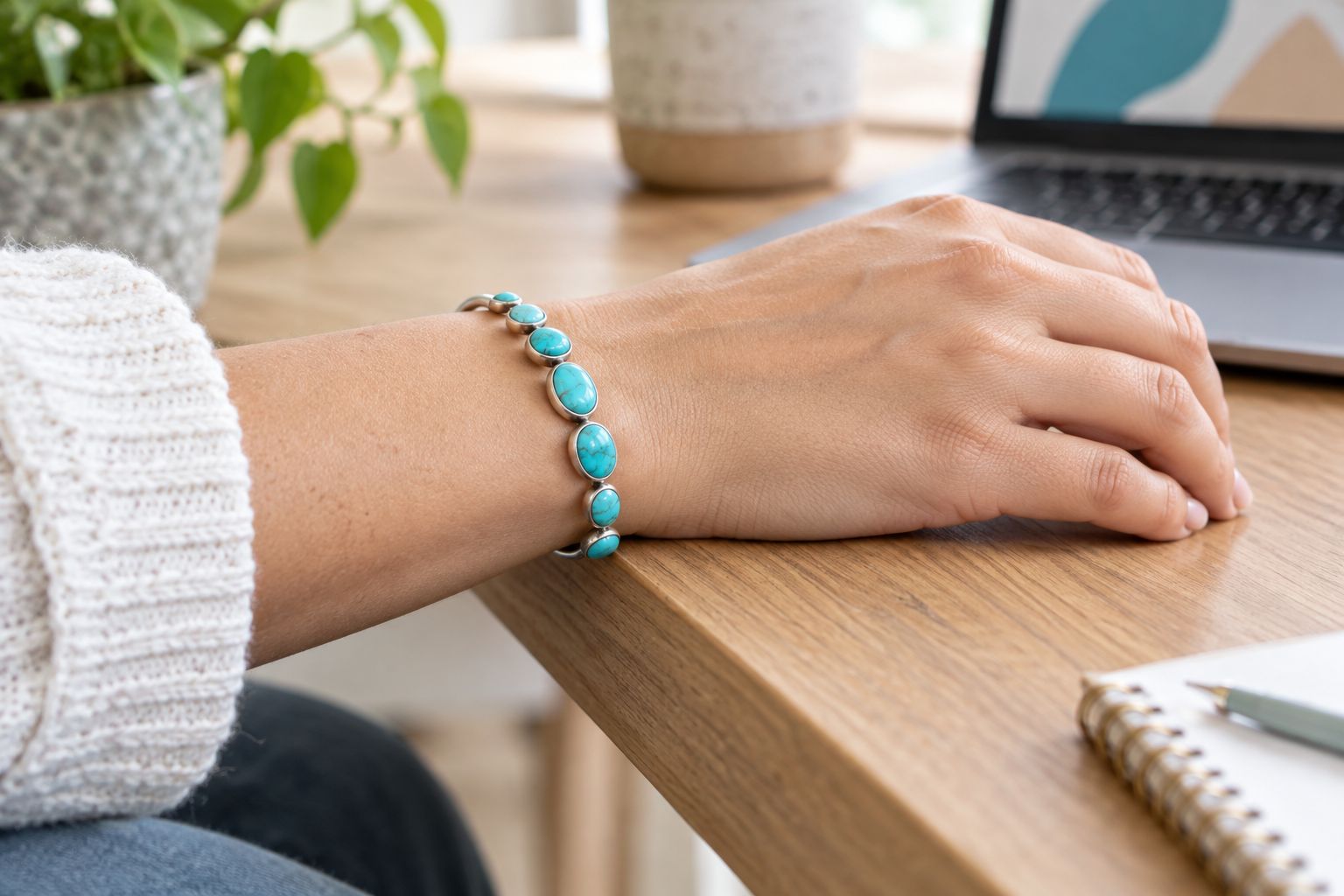
Yes, if your workday does not repeatedly press the stone against a desk or other hard surface. A bangle moves on the wrist, so consider where the turquoise sits when you type, lean on a counter or carry a bag. A design that keeps the stone away from the point of regular contact is easier to wear than one that places it directly against the desk.
Try the movements you make at work before deciding. Let your wrist rest where it normally rests, then check whether the stone or its metal setting strikes the surface. If contact is routine, reserve that bangle for occasions when you can protect it. The same test helps when assessing turquoise bracelets with prominent stones.
How should you care for turquoise jewellery you wear often?
Put turquoise jewellery on after applying perfume, cosmetics, lotion or hair products. Take it off before cleaning, bathing or exercising, and do not soak the stone as a routine cleaning method. After wear, use a soft, dry cloth and store the piece so the turquoise does not rub against other jewellery.
Keep the care plan specific to the finished piece. The metal and the stone do not always need the same treatment: a method used for gold or silver can be unsuitable for turquoise set into it. Ask a jeweller how to clean the complete piece before using a chemical polish, steam or ultrasonic cleaner.
Inspect frequently worn pieces for movement at the setting. If a stone shifts, stop wearing it until a jeweller checks it; cleaning will not fix a loose setting. For 2026 daily wear, this simple inspection matters more than trying to restore a neglected piece after damage appears.
Does the metal make turquoise safe for everyday wear?
No. A gold or silver setting can help protect an edge, but metal purity does not change the turquoise's scratch resistance. Look at how the metal holds the stone, not just what metal the design uses. A well-protected edge is relevant to wear; a purity mark answers a different question.
Auram Jewellery sells BIS hallmarked gold and silver jewellery, according to its supplied brand description. A gold hallmark is relevant when you are checking the gold; it does not certify the identity, treatment or durability of an accompanying turquoise stone. Likewise, IGI certification mentioned for Auram Jewellery's diamonds does not, by itself, tell you anything about turquoise in a different piece. Ask separate questions about the metal, the stone and the setting.
FAQ
Is turquoise jewellery good for daily wear in 2026?
Yes, turquoise jewellery is good for daily wear in 2026 when the stone is protected and you remove the piece before knocks, chemicals and prolonged water contact. Earrings and pendants are easier regular choices than exposed rings.
What's the best turquoise jewellery for everyday use?
Turquoise earrings or a pendant are the best starting choices for everyday use because they usually avoid the direct contact a ring or bangle receives. Check that the stone sits securely in its setting.
Is turquoise too soft for an everyday ring?
Turquoise can work in an everyday ring if you wear it selectively and protect it from knocks. GIA lists turquoise at 5–6 on the Mohs hardness scale, so an exposed ring needs more care than earrings or a pendant.
Can I wash my hands while wearing a turquoise ring?
Remove a turquoise ring before washing your hands when practical. This keeps repeated water and soap contact away from the stone and lets you dry your hands without rubbing it.
Can I shower with turquoise jewellery?
Take turquoise jewellery off before showering. Keeping the stone away from prolonged water contact and bathing products is a simpler care routine than trying to clean the piece afterward.
Does a gold setting make turquoise more durable?
A protective gold setting can shield the stone's edges, but it does not change the turquoise itself. Judge the design by how securely it holds the stone and which parts remain exposed.
Can I use a jewellery cleaner on turquoise?
Do not use a jewellery cleaner on turquoise unless a jeweller confirms it suits the specific finished piece. Wipe the jewellery gently with a soft, dry cloth instead.
Should I buy a turquoise bangle for daily office wear?
Choose a turquoise bangle for daily office wear only if the stone avoids repeated contact with your desk and other hard surfaces. Test where the bangle sits when you type and rest your wrist.
One last thing
The most useful test is not whether turquoise is labelled suitable for everyday wear. Rest your hand or wrist where it normally goes during the day and see whether the stone makes contact. If it does, change the design or choose earrings or a pendant. That small check turns a general care rule into a decision you can use in 2026.