Antique gold jewellery holds its value as bullion, but it almost never returns what you originally paid for craftsmanship, stones, or sentimental premium when you sell it back. Treat inherited or vintage gold as a way to preserve wealth already stored in gold, not as a growth investment — the return depends entirely on purity verification, hallmark status, and the gold rate on the day you sell it in 2026.
- Is antique gold jewellery a good investment? Only for the metal value — making charges and craftsmanship premium are almost never recovered at resale.
- 22K gold is 916 purity under BIS rules; antique pieces without this hallmark need lab testing before a jeweller quotes a firm price.
- Digital gold, gold coins, and new BIS hallmarked jewellery are more liquid than heirloom pieces bought before hallmarking became standard practice.
- Auram Jewellery accepts old gold in exchange toward a new BIS hallmarked or bespoke design once purity is verified.
Why this matters
Most Indian households hold a meaningful share of family wealth in gold jewellery, much of it inherited across generations before uniform hallmarking existed. When that gold needs to be sold, gifted forward, or converted into a new design, the number a jeweller quotes often disappoints families expecting the shop price plus years of gold appreciation.
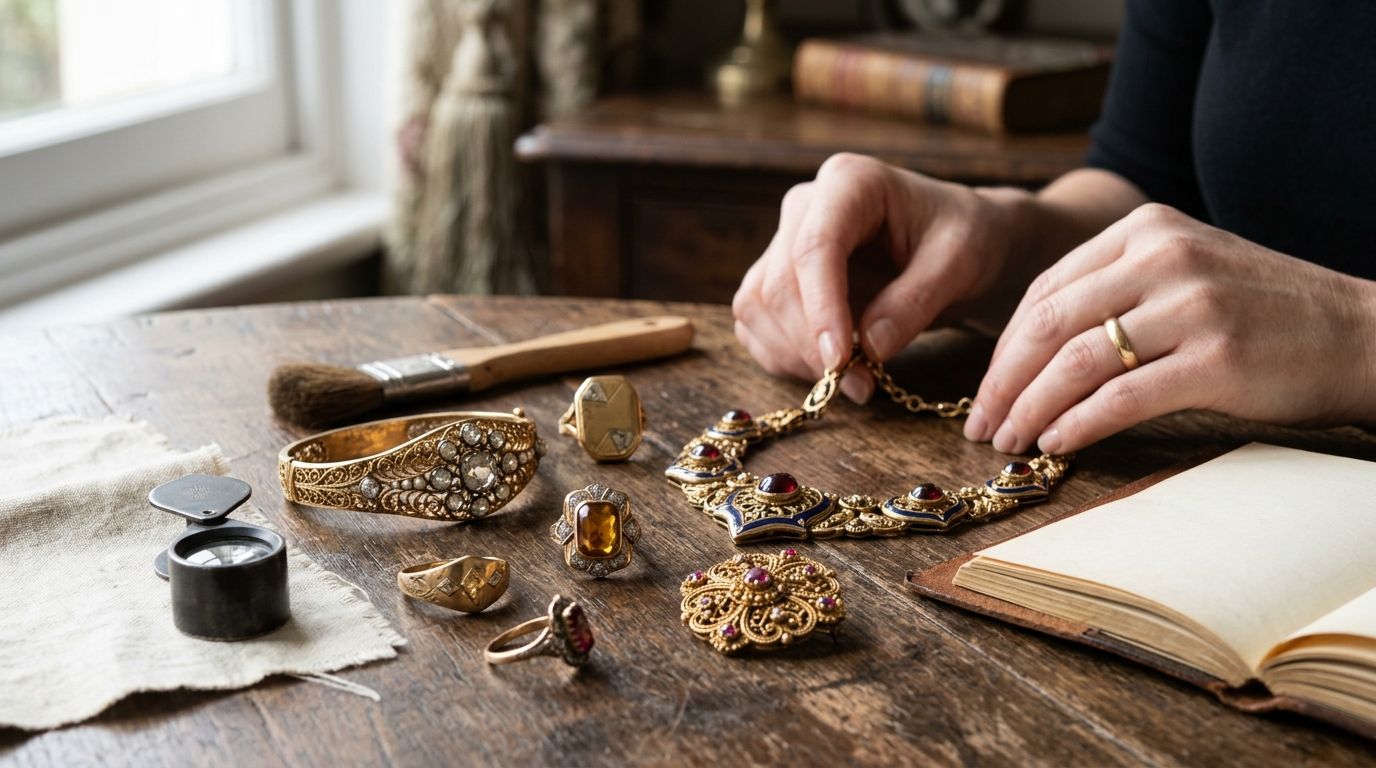
The gap comes down to one fact: jewellers pay for gold content, not for the work that went into making the piece. A heavy antique necklace with intricate filigree cost significant labour to produce decades ago — none of that labour value survives resale. Understanding this before you sell, or before you buy antique pieces as an investment, changes how you value what's already in your almirah, and it's worth checking Auram Jewellery's BIS hallmarked collections as a benchmark for what verified purity actually looks like today.
Is antique gold jewellery a good investment?
Compare antique gold against the two alternatives most Indian buyers actually weigh it against: newly purchased BIS hallmarked jewellery, and non-jewellery gold instruments like coins or digital gold.
| Asset | Purity verification | Liquidity | What you lose at resale | Best for |
|---|---|---|---|---|
| Antique/heirloom gold jewellery | Often unverified — needs testing | Low to moderate | Making charges, craftsmanship premium, wastage deduction | Families holding for sentiment or occasional reuse |
| New BIS hallmarked gold jewellery | HUID number, verified at purchase | Moderate | Making charges only (metal value protected by hallmark) | Buyers who want wearable jewellery with resale clarity |
| Gold coins, bars, digital gold | Certified purity, no craftsmanship cost | High | Minimal — mostly tracks metal price | Buyers prioritising liquidity over wearability |
The quotable verdict: antique gold jewellery is a reasonable store of value for gold you already own, but it is a poor vehicle to buy into fresh if pure investment return is the goal — coins or hallmarked bars track the metal price far more directly. If you're buying gold specifically to wear and eventually convert, checking whether BIS hallmarking is mandatory for gold jewellery in India before you commit tells you what protection you'll actually have at resale.
Why resale value on antique gold varies
No two heirloom pieces quote the same, even at identical weight. The spread comes from a small, predictable set of factors:
- Hallmark status — a piece with a BIS 916 mark on 22K gold gets a faster, more confident quote than an unmarked piece needing assay.
- Purity testing outcome — old gold sometimes tests below the karat it was sold as, especially pre-liberalisation pieces mixed with alloy for durability.
- Making charges paid originally — heavily worked antique pieces (filigree, kundan-set, temple designs) carried high making charges that never transfer to resale value; see how making charges on gold jewellery in India are structured to understand what's non-recoverable.
- Gold price on the sale date — the one variable working in your favour; gold bought decades ago benefits from decades of price appreciation on the metal component alone.
- Stone and gem value — antique pieces with uncertified stones get valued for the metal only; the stones are usually excluded or heavily discounted unless separately certified.
- Buyer type — a jeweller offering exchange toward new stock, a bullion dealer, and an auction house will each quote differently for the same piece.
Is old gold jewellery worth more than new gold jewellery?
Old gold jewellery is worth more only in raw metal terms if the gold price has risen since it was bought — the craftsmanship value baked into the original price does not carry forward. A 20-year-old necklace benefits from 20 years of gold appreciation on its metal weight, but the making charges paid in that original year are gone for good.
Can antique gold be sold without a BIS hallmark?
Yes, antique gold can be sold without a BIS hallmark, but it will be tested for purity first, and unmarked pieces typically get a more conservative quote than hallmarked ones because the buyer is absorbing the verification risk. Getting purity checked before you approach a buyer, rather than after, keeps the negotiation on your terms.
How does gold price at the time of sale affect an old piece's value?
Gold price on the sale date sets the floor for what any antique piece is worth, since jewellers price by current rate times verified gold weight, not by what you originally paid. Watching the rate before selling — rather than selling on a random day — is the single biggest lever you control on an antique piece.
Families converting inherited pieces into current designs go through a defined path: verify purity, confirm current gold weight, then apply that value toward a new commission. Exchanging old gold jewellery for a new design works this way at Auram Jewellery, with BIS hallmarking and IGI-certified stones applied to whatever gets remade.
See How Old Gold Converts to New
Understand the exchange workflow before you take heirloom pieces to be valued.
FAQ
Is antique gold jewellery a good investment in 2026?
Antique gold jewellery is a reasonable store of value for gold you already hold, but a weak choice if you're buying purely for investment return in 2026 — gold coins or hallmarked bars track the metal price more directly without a craftsmanship premium attached.
What purity is most antique Indian gold jewellery?
Most antique Indian gold jewellery is close to 22K (916 purity), though older pieces sometimes test lower due to alloy mixed in for durability decades ago. Testing before resale confirms the actual purity rather than assuming the karat it was originally sold as.
Does antique gold jewellery lose value without IGI certification on its stones?
Yes, antique gold jewellery with uncertified stones typically gets valued for the metal alone, with stones discounted or excluded from the quote. Getting stones independently certified before resale can recover some of that lost value if the stones are genuinely valuable.
Is gold jewellery a better investment than gold coins or digital gold?
Gold coins and digital gold are better pure investments than jewellery because they carry no making charges and are priced directly against the gold rate. Jewellery works better when you also want to wear the asset, not just hold it.
Can inherited gold jewellery be exchanged for BIS hallmarked pieces?
Yes, inherited gold jewellery can be exchanged toward BIS hallmarked pieces after purity verification confirms the actual gold content. The exchanged value applies as credit toward the new piece, not as a cash refund of the original purchase price.
How do making charges affect the resale value of antique gold?
Making charges paid on antique gold jewellery are almost never recovered at resale, since buyers pay for verified gold weight at current rates, not for the labour that went into the original design. Heavily worked pieces lose the most relative value for this reason.
Do jewellers deduct anything besides purity when buying back old gold?
Jewellers typically account for wastage during melting and testing when buying back old gold, on top of paying only for the verified gold content. This is separate from, and in addition to, the making charges already lost from the original purchase.
One last thing
The gold in an antique piece never stops being an asset — only the craftsmanship around it stops counting the moment you decide to sell rather than wear it. If a family piece has real sentimental or design value, converting it into a new commission rather than selling it outright is usually the better move in 2026, since the gold weight carries forward as credit instead of being cashed out at a discount.