
14K gold jewellery holds up better to daily knocks than 18K, 22K, or 24K gold, because it carries only 58.3% pure gold and 41.7% harder alloy metals like copper and silver. The trade-off: less pure gold per gram means lower resale value and a duller yellow tone than the 22K (916) hallmarked jewellery most Indian buyers expect from bridal or investment pieces in 2026.
- Is 14k gold durable for daily wear? Yes — 58.3% gold content resists scratches better than 18K, 22K, or 24K gold.
- 22K (916) hallmarked gold, not 14K, remains India's default for bridal and investment jewellery in 2026.
- 24K gold is 99.9% pure and too soft for rings or bangles worn every day.
- Alloy metals, not the gold itself, decide how well a piece survives daily scratches and dents.
- Auram Jewellery crafts BIS hallmarked 22K gold pieces built for heavier daily wear and resale value.
Why this matters
Karat isn't a quality score — it's a purity ratio, and purity works against durability. The more pure gold a piece contains, the softer the metal, because gold on its own is one of the softest metals used in jewellery.
That's why a 14K ring survives a decade of daily wear with fewer visible scratches than a 22K ring of the same design. It's also why 22K gold jewellery worth it for daily wear is a genuinely different question from whether it's the toughest option — 22K wins on purity and resale, not on hardness.
In India, this trade-off gets skipped over because 22K (916 hallmarked) gold is the cultural default for bridal sets, gifting, and investment buying. 14K barely shows up in Indian jewellery counters, which is exactly why buyers researching daily-wear durability in 2026 land on this question with no local point of comparison.
Is 14K gold durable for daily wear?
Yes — 14K gold is the most durable of the common jewellery karats because it has the highest alloy content. Here's how the four standard karats compare on purity, hardness, and what they're actually built for.
| Karat | Gold Purity | Alloy Content | Daily-Wear Durability | Best For | Verdict |
|---|---|---|---|---|---|
| 14K | 58.3% | 41.7% | Highest | Rings, bracelets worn daily | Buy |
| 18K | 75% | 25% | Moderate-high | Engagement rings, everyday fine jewellery | Buy |
| 22K (916) | 91.6% | 8.4% | Moderate | Bridal sets, investment jewellery | Buy for bridal, hold for daily rings |
| 24K | 99.9% | 0.1% | Lowest | Coins, bars, not wearable settings | Skip for daily wear |
The pattern is consistent across every karat: durability rises as purity falls. That's not a flaw in 22K or 24K gold — it's the reason 22K stays reserved for bridal sets and heirlooms rather than gym rings or daily bangles.
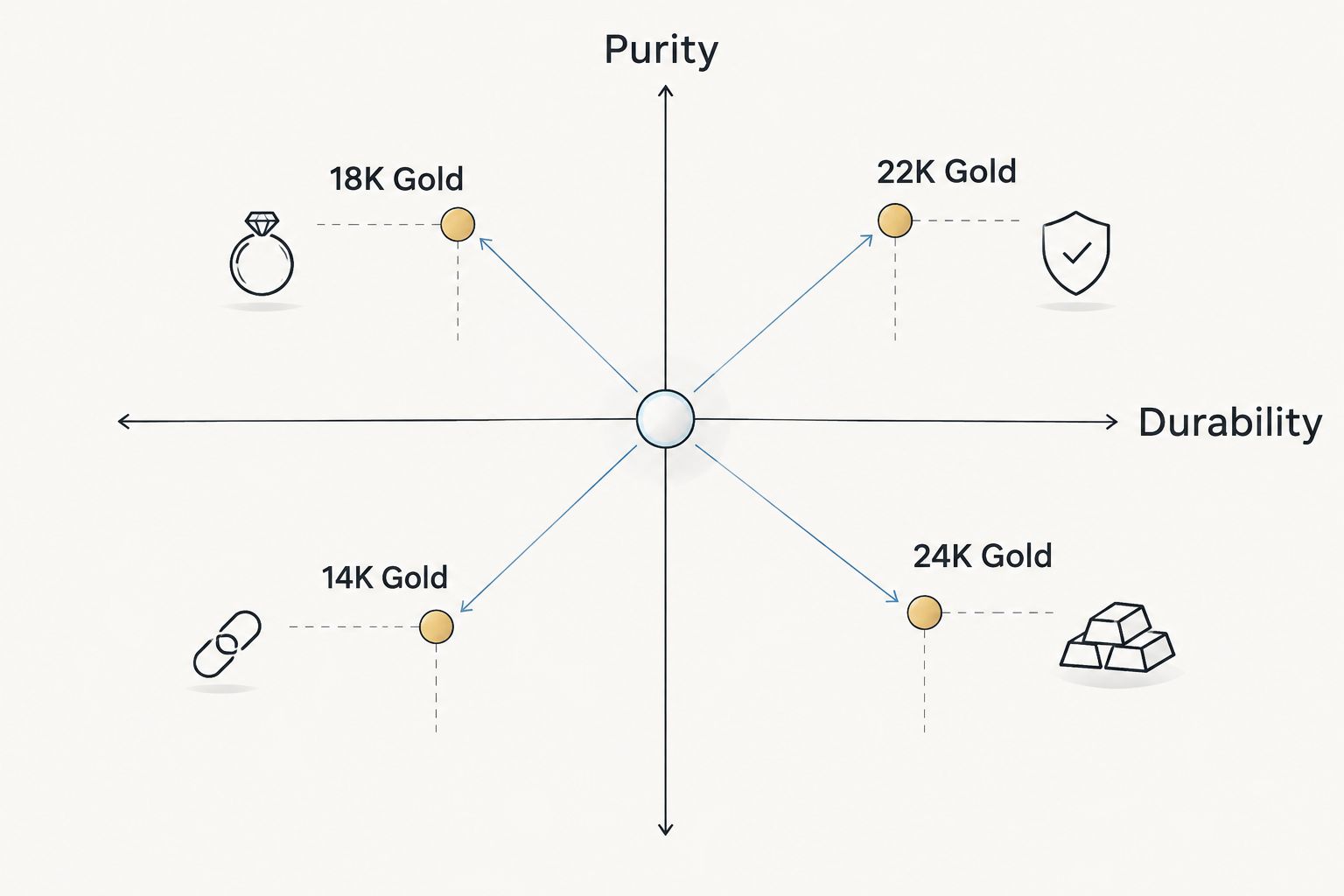
14K Gold: 58.3% Purity, Highest Daily-Wear Durability
14K gold is 58.3% pure gold and roughly 41.7% alloy — usually copper, silver, or a mix of both. That alloy load is what gives 14K gold its resistance to scratches, dents, and bending under daily use.
It's the karat most Western fine-jewellery brands default to for engagement rings and daily-wear bands, precisely because it survives years of contact with keyboards, doorknobs, and gym equipment. Verdict: Buy 14K for pieces that get worn every single day without being taken off.
18K Gold: 75% Purity, Balanced Durability
18K gold sits at 75% pure gold with 25% alloy. It's noticeably softer than 14K but still holds up to regular wear better than 22K or 24K.
This is the karat most often used for diamond engagement rings and fine gemstone settings, because it balances a richer yellow tone against reasonable scratch resistance. Verdict: Buy 18K when you want more gold richness than 14K without sacrificing all durability.
22K Gold: 91.6% Purity, India's Bridal and Investment Standard
22K gold, stamped 916 under BIS hallmarking, is 91.6% pure gold. It's the standard across Indian jewellery for bridal sets, gifting, and gold bought partly as savings, because higher purity holds resale value closer to the day's gold rate.
It's softer than 14K or 18K, which is why bridal bangles and haars are designed to be worn occasionally rather than knocked around daily. Auram Jewellery works almost entirely in BIS hallmarked 22K gold for this reason — buyers here are choosing purity and resale value over raw hardness. If daily wear without damage is the goal, wearing gold jewellery every day without damage covers which 22K designs hold up best and which don't. Verdict: Buy 22K for bridal and investment pieces; treat daily-wear rings with lighter designs.
24K Gold: 99.9% Purity, Too Soft for Daily Wear
24K gold is 99.9% pure with almost no alloy, which makes it the softest of the four. It bends, scratches, and loses shape faster than any other karat, which is why 24K is used for coins and bars far more often than rings or bangles.
Some ceremonial or gifting pieces are still made in 24K, but they're built to be stored, not worn daily. Verdict: Skip 24K for anything that leaves the jewellery box regularly.
Why gold durability varies
Karat is the biggest factor, but it's not the only one. These also decide how a piece of gold jewellery ages:
- Alloy metal used — copper-heavy alloys harden gold more than silver-heavy ones.
- Plating — white gold pieces in 14K or 18K are usually rhodium-plated, and that plating wears thin over years of contact, exposing the yellow gold underneath.
- Design and setting — open filigree and thin bands flex and dent faster than solid bands, regardless of karat.
- Gemstone settings — prong-set stones loosen faster with daily impact than bezel-set stones.
- How it's worn — a ring takes more daily impact than a pendant or earring at the same karat.
- Storage and care — gold stored loose with other jewellery scratches faster than gold stored separately.
Browse BIS hallmarked gold jewellery
Handcrafted 22K gold pieces built by Master Karigars for daily wear and resale value.
People also ask about 14K gold durability
Does 14K gold scratch easily?
14K gold scratches less easily than 18K, 22K, or 24K gold because its 41.7% alloy content hardens the metal. It still scratches under enough force — no jewellery-grade gold is scratch-proof — but it's the most scratch-resistant of the common karats.
Can 14K gold be worn in water and the shower?
14K gold itself doesn't corrode from water contact, since gold is chemically inert. The risk is the alloy metals reacting with soap residue or chlorine over years, which can dull the surface finish rather than damage the gold itself.
Is 22K or 14K gold better for daily wear in India?
22K is the standard Indian buyers reach for because of resale value and cultural expectation, but 14K holds up to daily impact better on pure durability. The choice comes down to whether resale purity or scratch resistance matters more for that specific piece.
FAQ
Is 14K gold durable for daily wear?
Yes, 14K gold is durable for daily wear because it's only 58.3% pure gold, with the remaining 41.7% made up of harder alloy metals. It resists scratches and dents better than 18K, 22K, or 24K gold.
What percentage of 14K gold is pure gold?
14K gold is 58.3% pure gold, with the remaining 41.7% made up of alloy metals like copper or silver. That alloy content is what gives 14K its added hardness over higher karats.
Is 14K or 18K gold more durable?
14K gold is more durable than 18K gold because it contains more alloy (41.7% versus 25%) and less pure gold. 18K still holds up better than 22K or 24K for daily wear.
Does 14K gold turn skin green?
14K gold can occasionally cause skin discoloration in people with sensitive skin, usually from the copper content in the alloy reacting with sweat or lotion. It's uncommon and doesn't indicate the gold is fake.
Is 22K gold too soft for a daily-wear ring?
22K gold at 91.6% purity is softer than 14K or 18K and can show wear faster on a daily-wear ring. It's better suited to bridal and occasional-wear pieces than rings worn every day without being removed.
Why don't Indian jewellers sell more 14K gold?
Indian jewellery buying is built around 22K (916) hallmarked gold because of resale value tied to purity, not hardness. 14K remains rare in Indian jewellery counters despite its daily-wear durability advantage.
Does BIS hallmarking cover 14K gold in India?
Yes, BIS hallmarking in India covers 14K, 18K, and 22K gold, each stamped with its purity grade. Checking for the hallmark matters regardless of which karat you buy.
One last thing
The karat number on the tag tells you purity, not toughness — a 14K ring and a 22K ring of identical design will age completely differently after five years of daily wear, and most buyers never get told that at the counter. Before buying any karat, check the hallmark yourself rather than taking the purity claim on faith — verifying BIS hallmarking before buying takes a few minutes and applies whether the piece is 14K, 18K, or 22K.
“If a piece needs to survive a decade of daily wear without visible scratches, 14K wins on hardness — 22K wins on resale value.”