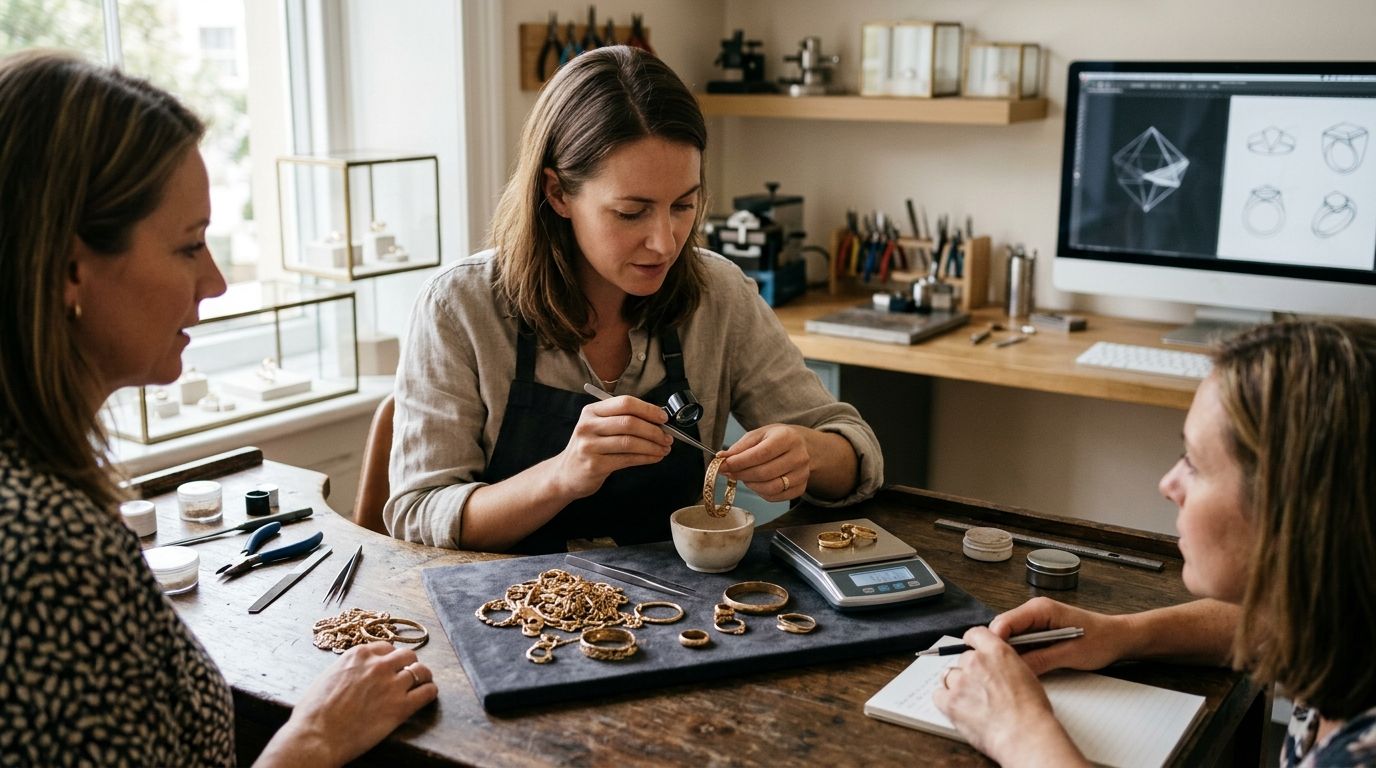
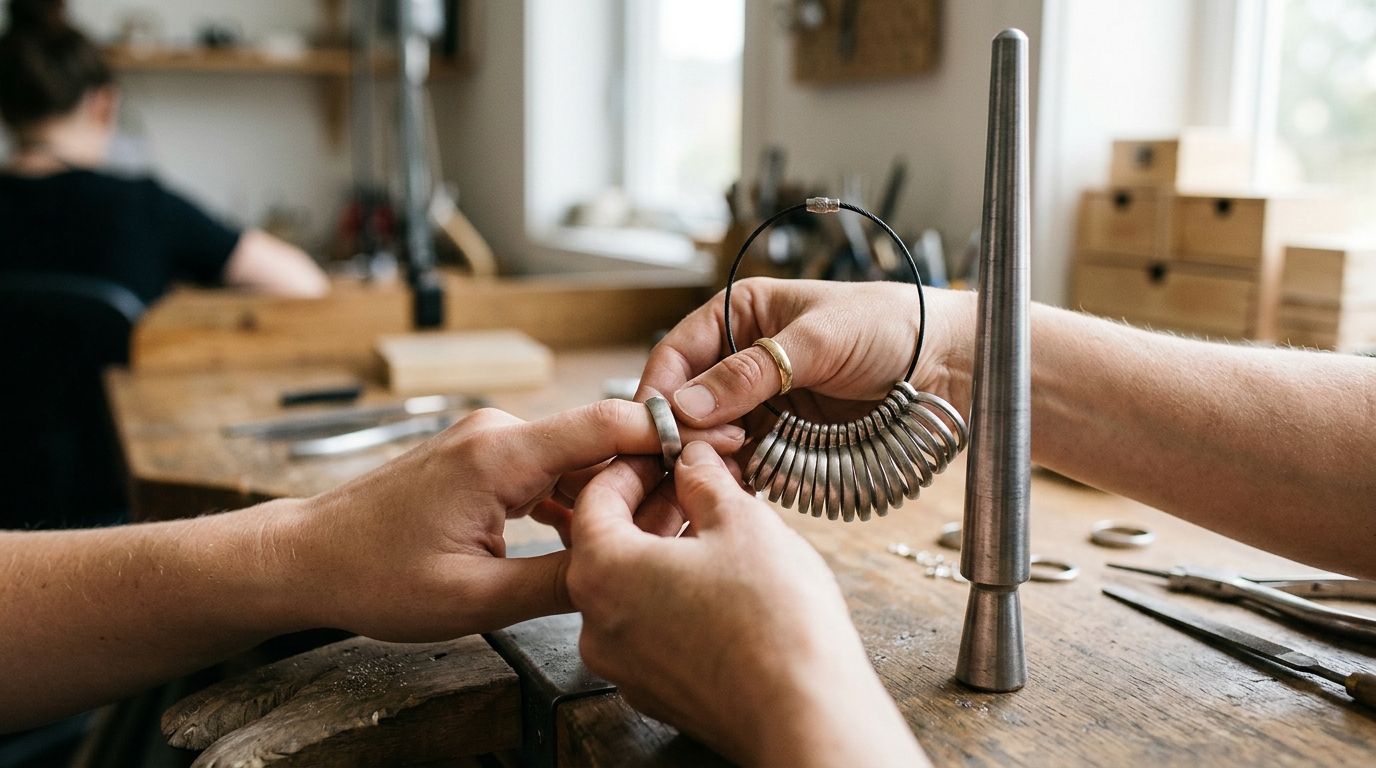
A ring bought on guesswork gets returned, reworked, or worn on a chain instead of a finger — and hallmarked gold and IGI-certified stone rings are not meant for repeated resizing. Instead of eyeballing a size or borrowing a family member's ring for reference, run a short measurement-to-fit workflow before you order or commission a piece, so the ring fits the first time it's slipped on.
- This ring size guide fitting workflow moves from string measurement to professional confirmation in under 20 minutes.
- Indian ring sizes typically run from 5 to 25; most adult women fall between size 10 and 16, most men between 18 and 24.
- Finger size shifts by about half a size between morning and evening, so measure at room temperature in the evening.
- Auram Jewellery confirms final fit through a video consultation with karigars before cutting or casting a bespoke ring.
- Most gold bands hold roughly two sizes of resizing range — heavily set stone rings hold less, so measure carefully upfront.
Why this matters
A hallmarked gold ring or an IGI-certified diamond ring isn't a mass-produced SKU you swap at a mall kiosk. Bridal sets, bespoke commissions, and stone-heavy designs have limited resizing range, and a wrong guess at the ordering stage means a delay while a karigar reworks the shank. Auram Jewellery builds fit confirmation into the commissioning process precisely because hallmarking and certification apply to purity and stone quality, not to size — that check happens separately, and it's on you to get it right before the metal is cast.
In 2026, most of this can happen without a store visit. A proper at-home measurement plus one video check with a karigar replaces two or three in-person fitting trips.
Before you start
- A soft measuring tape, a strip of paper, or a length of string, plus a ruler marked in millimeters — a fabric tape measure works better than a rigid one because it follows the curve of the finger.
- A ring you already own that fits well on the same finger, so you can cross-check its inner diameter against your new measurement.
- The one gotcha that trips up almost everyone: measure in the evening at room temperature, never right after waking or after exercise. Cold or swollen fingers can read up to half a size smaller or larger than they do by early evening, and that half-size gap is exactly where most fitting complaints come from.
Measure your finger size at home
- Wrap the string or paper strip snugly around the base of the finger you're sizing, just below the knuckle. Mark the point where it overlaps itself.
- Lay the marked string flat and measure the length in millimeters with your ruler. This is the finger's circumference at the base.
- Slide the same string over the knuckle to get a second, looser reading — the knuckle circumference. Expect this number to run 1 to 2mm larger than the base measurement; that gap is normal, not an error.
- Measure the inner diameter of a ring you already own and wear comfortably on that finger. Compare it against a standard ring size chart to sanity-check your string measurement.
Expected result: you now have two numbers — a snug base circumference and a looser knuckle circumference within 2-3mm of each other — plus a known-good reference ring. That's enough data to convert to an actual size in the next step.
Convert and confirm your ring size
- Match your base circumference in millimeters against a standard ring size conversion chart to get your equivalent Indian size. Indian ring sizes typically run from 5 to 25, with most adult women sizing between 10 and 16 and most men between 18 and 24.
- If the ring is for an imported design or a diamond solitaire quoted in US or UK sizing, convert both ways and note the Indian equivalent — that's the number a karigar will actually cut to.
- Cross-check your converted size against the reference ring's inner diameter from Step 4 above. If the two disagree by more than half a size, remeasure in the evening rather than trusting either number blindly.
- For a comfort-fit or wider band, round up to the next half size — wider bands sit tighter than thin bands at the same numeric size because more metal touches the skin.
Expected result: a single confirmed Indian ring size, cross-checked against a ring you already know fits, ready to hand to a jeweller or enter on an order form.
Confirm fit before committing to a cast
This is the step most self-measured orders skip, and it's the one that prevents rework on a hallmarked gold or IGI-certified piece.
- Book a video consultation with the bespoke jewellery team before the design is finalized for casting.
- Show the karigar your measurement method on camera — the string or paper strip and the reference ring — so a second set of eyes can catch a measurement error before metal is cut.
- For 22K gold rings for women with stone settings or an ornate shank, ask specifically about the resizing range built into that design, since decorative shanks resize less than a plain band.
- Confirm the final size verbally and get it noted against the order before commissioning begins.
Expected result: a confirmed size on record with the atelier, cutting the odds of a post-delivery resize down to near zero for a standard band.
Resizing an inherited or gifted ring
If you're not starting from a blank measurement but need to size an inherited or already-gifted ring, the workflow shifts slightly:
- Measure the ring's inner diameter directly with a ruler, not a printed chart — printed charts distort by 3-5% if your printer scales the page to fit, which throws the whole reading off.
- Compare that inner diameter against the base circumference method above, converting both to the same size scale.
- For diamond engagement rings with pave or halo settings, flag the setting style during the video consultation — these designs typically hold less resizing range than a solitaire on a plain band.
- Get a written estimate of how many sizes up or down the piece can safely go before committing to the resize.
Expected result: a resizing plan that respects the ring's setting, instead of a generic promise to make it work that risks the stone mount.
Troubleshooting
- Ring feels tight over the knuckle but loose at the base — this is the most common complaint. Size to the knuckle measurement, not the base, and ask about a comfort-fit inner edge.
- Morning and evening measurements don't match — average the two and lean toward the larger number; a slightly loose ring is easier to fix than a tight one that won't come off.
- A printed sizing chart doesn't match a ring you own — the printer likely scaled the page. Trust the physical reference ring over any printed chart.
- A correctly measured gold ring still spins on the finger — 22K gold is softer and thinner-walled than platinum at the same size, so it can feel looser even at the right number; a ring guard or slightly smaller size solves this.
- A heavily set bridal ring can't take the resize you want — stone-set shanks have less structural room than plain bands. This is exactly why the video consultation step exists before casting, not after.
Customize your workflow
This process scales up for bridal sets and bespoke commissions where more than one ring or a matched set needs sizing at once. For a wedding band paired with an existing engagement ring, measure both fingers separately — dominant-hand fingers often run slightly larger than non-dominant ones — and bring both reference measurements into the same video consultation.
For a first-time gold purchase or a gifting occasion where you're sizing for someone else discreetly, borrow a ring they already wear on the intended finger and measure its inner diameter rather than guessing from a verbal estimate.
Get your ring size confirmed by a karigar
Book a video consultation before your bespoke piece goes into casting.
FAQ
What's the best way to measure ring size at home in 2026?
Wrap a string or paper strip around the base of the finger, mark the overlap, and measure the length in millimeters against a ring size chart. Cross-check it against a ring you already own that fits, and measure in the evening at room temperature for the most accurate reading.
How much does finger size change during the day?
Finger size can shift by about half a size between a cold morning and a warm evening. Measure in the evening at room temperature for the most reliable number, and avoid measuring right after exercise or exposure to cold.
Can a hallmarked gold ring be resized after purchase?
Most plain gold bands can be resized within about two sizes up or down without issue. Heavily set stone rings and ornate bridal shanks hold less resizing range, so confirming fit before casting matters more for those designs.
Is a printed ring size chart accurate?
Only if it prints at exactly 100 percent scale. Most printers default to fit-to-page, which distorts the chart by a few percent, so comparing against a ring you already own that fits is more reliable than a printout alone.
What size should I choose for a wide band versus a thin band?
Wide bands sit tighter than thin bands at the same numeric size because more metal contacts the skin. Round up to the next half size for a wide comfort-fit band.
How does Auram Jewellery confirm ring size for bespoke commissions?
Auram Jewellery confirms final size through a video consultation with karigars before a bespoke ring goes into casting. The customer shows their measurement method on camera so a second check catches errors before the metal is cut.
Should I size for the knuckle or the base of the finger?
Size for the knuckle if it is noticeably larger than the base, since a ring has to pass over the knuckle to be worn at all. A comfort-fit inner edge helps a ring sized for the knuckle sit properly at the base too.
Does BIS hallmarking or IGI certification confirm ring size?
No. BIS hallmarking verifies gold purity and IGI certification verifies diamond quality, and neither relates to ring size. Size confirmation happens separately, during measurement and fitting.
One last thing
BIS hallmarking stamps confirm gold purity, and IGI certificates confirm diamond quality — neither document says anything about size. That's the detail most first-time buyers miss: a hallmark on the inside of the shank tells you the gold is 916 or 22KT, not that the ring will fit. Size confirmation is a separate step, and skipping it is the single most avoidable reason a bespoke piece needs rework after delivery in 2026.