Best overall: lab-grown diamond studs. Best for a size-independent gift: a solitaire pendant. Best for an engagement: a solitaire ring. This 2026 guide ranks lab grown diamond jewellery by wearability, setting security and occasion, rather than treating the largest stone as the best purchase.
- Lab grown diamond jewellery: choose studs for everyday wear, a solitaire pendant for gifting, and a solitaire ring for engagement.
- Auramjewellery suits bespoke jewellery buyers seeking handcrafted work; establish diamond origin before approving a commission.
- A diamond grading report and a gold hallmark answer different questions. Check both before buying.
- Choose lab-grown diamond earrings and rings by fit, setting security and documented stone details—not appearance alone.
Why this matters
A beautiful diamond does not automatically make a comfortable piece of jewellery. An awkward earring back, raised ring setting or twisting pendant changes how often you wear it. Choose the jewellery format first, then assess the diamonds within it.
Auramjewellery offers handcrafted gold, diamond and silver jewellery, bridal collections and bespoke commissions. Its stated credentials include BIS-hallmarked gold and IGI-certified diamonds; establish the origin of the diamonds specified for your particular piece rather than treating certification as proof that they are lab-grown.
For a 2026 purchase, separate three decisions: the occasion, the construction and the documentation. A grading report describes a diamond. It does not tell you whether an earring feels balanced or a bracelet clasp is easy to operate.
What makes the best lab grown diamond jewellery?
Use these criteria before comparing designs. They apply to ready-made pieces and bespoke commissions alike.
- Wearability: Check how the piece sits against your ear, neckline, finger or wrist. Judge it with the clothes you intend to wear.
- Setting security: Inspect stone seats, prongs, edges and closures. Reject visible looseness, uneven finishing or a clasp that does not engage properly.
- Diamond documentation: Ask for clear lab-grown disclosure and documentation appropriate to the stones. Establish which diamonds any grading report covers.
- Metal suitability: Confirm the alloy and hallmark, then assess the design. Metal purity alone does not establish a finished piece's durability.
- Maintenance access: Ask how the setting is cleaned, inspected and repaired. Elaborate designs need a practical care plan.
- Personal fit: Match the recipient's habits, not just the occasion. Pierced ears, ring size and preferred necklace length matter.
Best lab-grown diamond jewellery at a glance
These are ranked design formats, not named products or claims about a particular jeweller's catalogue. Each option has a distinct role; the table order matches the recommendations below.
| Jewellery format | Best for | Standout feature | Key limitation |
|---|---|---|---|
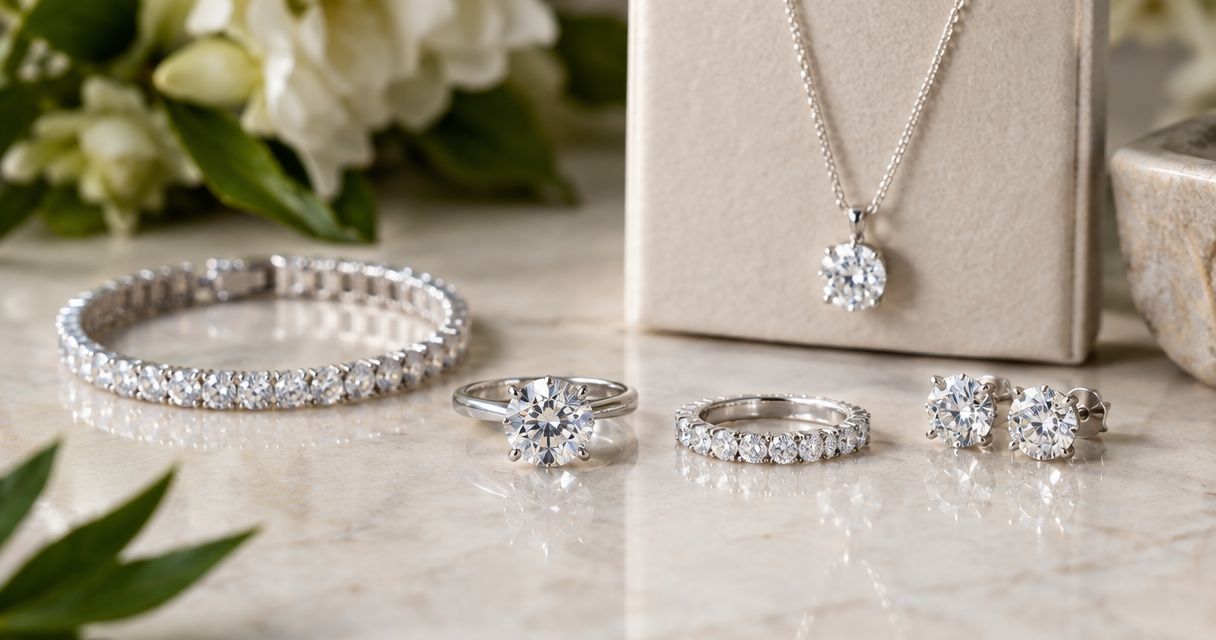
| Lab-grown diamond studs | Everyday versatility | Compact profile without a hanging element | Backing comfort and security need checking |
| Solitaire pendant | Size-independent gifting | A single focal point at the neckline | Chain length and pendant balance affect wear |
| Solitaire ring | Engagement or a personal milestone | One centre stone anchors the design | Accurate sizing and setting height matter |
| Diamond hoops | A visible accent for social occasions | Diamonds follow a curved earring profile | Diameter and hinge construction affect comfort |
| Tennis bracelet | Continuous wrist sparkle | Repeating articulated stone settings | Clasp security and wrist fit require attention |
| Bridal drop earrings | Framing the face with occasionwear | Movement and length complement formal styling | Weight and snagging restrict everyday use |
1. Lab-grown diamond studs: best for everyday versatility
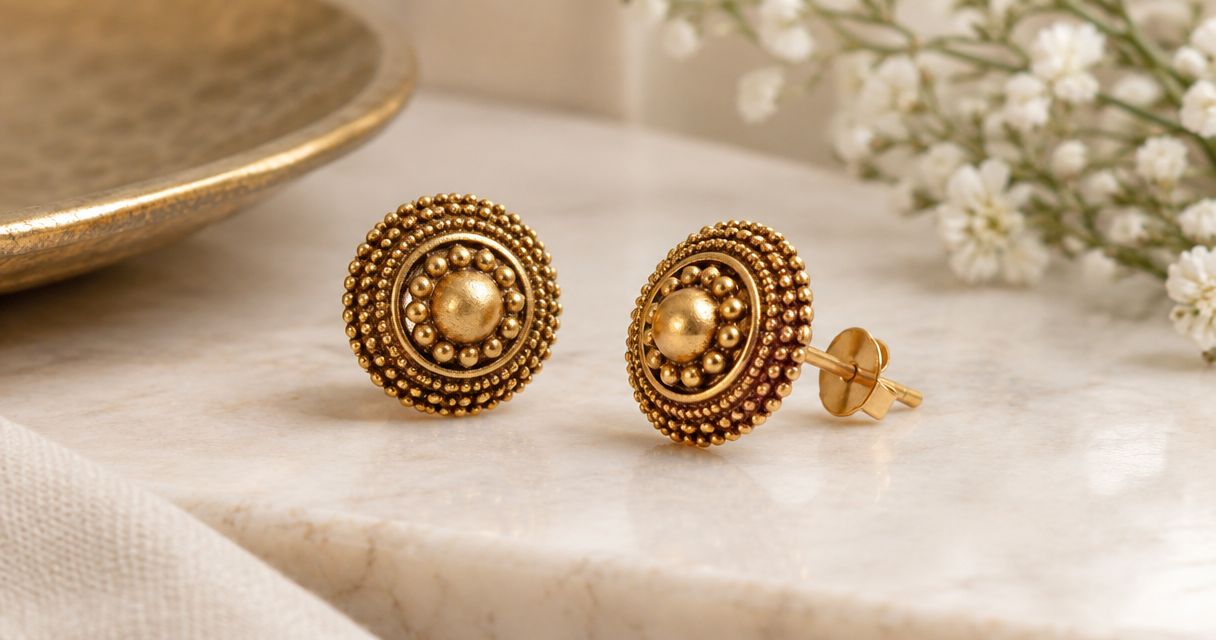
Lab-grown diamond studs place a diamond or compact diamond arrangement close to the earlobe. With no hanging section, they are the clearest starting point for a jewellery wardrobe in 2026. Choose the face-up appearance you like, then inspect the profile and backing.
A stud's comfort depends on more than its visible diameter. The post, basket and back all touch or sit close to your ear, so try the complete earring rather than judging a front-facing photograph.
Lab-grown diamond studs pros:
- A compact silhouette works with casual and formal clothing.
- The absence of a hanging section keeps the styling restrained.
- You can assess matching stones side by side.
Lab-grown diamond studs cons:
- A poorly fitting back can pinch or sit insecurely.
- A deep basket can project farther from the ear than expected.
Best for: Someone who wants one understated pair to wear across different settings.
Verdict: Buy studs as your default first piece, after checking the backs, paired appearance and lab-grown disclosure.
2. Solitaire pendant: best for size-independent gifting
A solitaire pendant places a single diamond at the neckline, making it a practical alternative when you do not know a recipient's ring size. The chain and setting deserve as much attention as the stone. A pendant that tips forward or catches on its chain loses the simplicity you chose it for.
Check where it sits against the recipient's usual necklines. A fixed setting and a pendant suspended from a bail behave differently, so ask to see the necklace worn rather than displayed flat.
Solitaire pendant pros:
- It avoids the exact sizing required for a ring.
- A single focal point keeps the design easy to style.
- The stone and its setting are straightforward to examine closely.
Solitaire pendant cons:
- An unsuitable chain length changes the intended appearance.
- A poorly balanced setting can turn or tilt during wear.
Best for: An anniversary or milestone gift when neckline preferences are clearer than ring size.
Verdict: Buy a solitaire pendant for gifting when you can confirm the chain length and see how the setting hangs.
3. Solitaire ring: best for an engagement or personal milestone
A lab-grown diamond solitaire ring gives one centre stone the main visual role. The setting determines how that stone sits above the finger and how the ring interacts with clothing or an accompanying band. Assess the side view before approving the design.
For your 2026 engagement purchase, check the intended wedding-band pairing at the same time. A ring that looks balanced alone does not necessarily sit comfortably beside another band.
Solitaire ring pros:
- The design keeps attention on the centre diamond.
- A defined centre setting makes its construction easier to inspect.
- The silhouette can be discussed clearly in a bespoke brief.
Solitaire ring cons:
- A raised setting can catch on fabrics.
- Incorrect sizing affects comfort and security.
Best for: A buyer choosing an engagement ring or a personally significant piece with a known ring size.
Verdict: Buy once fit, setting height and the centre stone's documentation are settled—not from a top-view photograph alone.
4. Diamond hoops: best for a visible social accent
Diamond hoops combine a curved earring shape with stones arranged along part or all of that curve. They give you a more noticeable outline than studs without the length of bridal drops. Decide whether you want close-fitting hoops or a larger silhouette before comparing diamond coverage.
Operate the closure yourself. The hinge, post alignment and fastening are functional parts of the design, not details to overlook because the front looks polished.
Diamond hoops pros:
- The curved outline provides a visible styling accent.
- Different diameters create distinct proportions against the face.
- Stone placement can emphasise the front-facing portion of the hoop.
Diamond hoops cons:
- Larger hoops have more exposed surface to catch on clothing.
- An awkward hinge or closure makes putting them on difficult.
Best for: Someone who already owns simple earrings and wants a more defined evening or social look.
Verdict: Buy hoops as a second pair after checking diameter, weight and closure operation.
5. Tennis bracelet: best for continuous wrist sparkle
A tennis bracelet connects repeating diamond settings into an articulated line. Its appeal comes from consistency: the stones, links and spacing read as one continuous piece. Inspect the bracelet while it moves, not only while it lies straight in a tray.
Try fastening it without assistance. A bracelet belongs on a moving wrist, so excessive slack, stiff articulation or an uncertain clasp should stop the purchase.
Tennis bracelet pros:
- Repeating settings create a continuous diamond line.
- Articulated links follow the wrist rather than forming a rigid cuff.
- The format adds jewellery without changing your neckline or earrings.
Tennis bracelet cons:
- Numerous settings create more inspection points.
- Fit and clasp security need particular attention.
Best for: A buyer who prefers wrist jewellery and is prepared to arrange regular setting inspections.
Verdict: Hold until you have tried the fit, articulation and clasp; appearance alone is insufficient.
6. Bridal drop earrings: best for framing occasionwear
Lab-grown diamond drop earrings bring length and movement beside the face. Their strongest role is an occasion-led outfit where the hairstyle, neckline and other jewellery are already considered. Choose them with the whole bridal look, not as an isolated close-up.
Test the earrings while turning your head and looking down. Hair, embroidery and a veil can interact with a drop design in ways a jewellery display cannot show.
Bridal drop earrings pros:
- Length creates a clear frame around the face.
- Movement contributes to their occasion-led appearance.
- The design can complement an outfit without requiring a necklace.
Bridal drop earrings cons:
- Weight can make prolonged wear uncomfortable.
- Hanging details can catch in hair or embellished fabric.
Best for: A bride or occasionwear buyer choosing earrings around a planned hairstyle and neckline.
Verdict: Buy for a defined outfit after a comfort trial; skip them as your only everyday pair.
Check diamond origin, gold purity and construction separately
Lab-grown diamonds are diamonds, not cubic zirconia or moissanite. Their manufactured origin must be disclosed clearly. Visual appearance alone is not a reliable way to establish whether a diamond is natural or laboratory-grown.
For a 2026 shortlist, ask what the documentation covers. A report for a centre stone does not automatically describe every smaller diamond in a finished piece. Match the report details to the stone being sold and ask the jeweller to explain any identification method.
Gold purity is a separate check. 18KT gold contains 75% gold, while 22KT gold contains approximately 91.7% gold; the remaining portion consists of alloying metals. Do not choose a setting solely because its gold purity is higher.
Diamond ranks 10 on the Mohs hardness scale, which measures resistance to scratching—not resistance to every kind of impact. A diamond can still chip, and a setting can still suffer damage. Remove jewellery for activities that expose it to knocks, abrasion or chemicals.
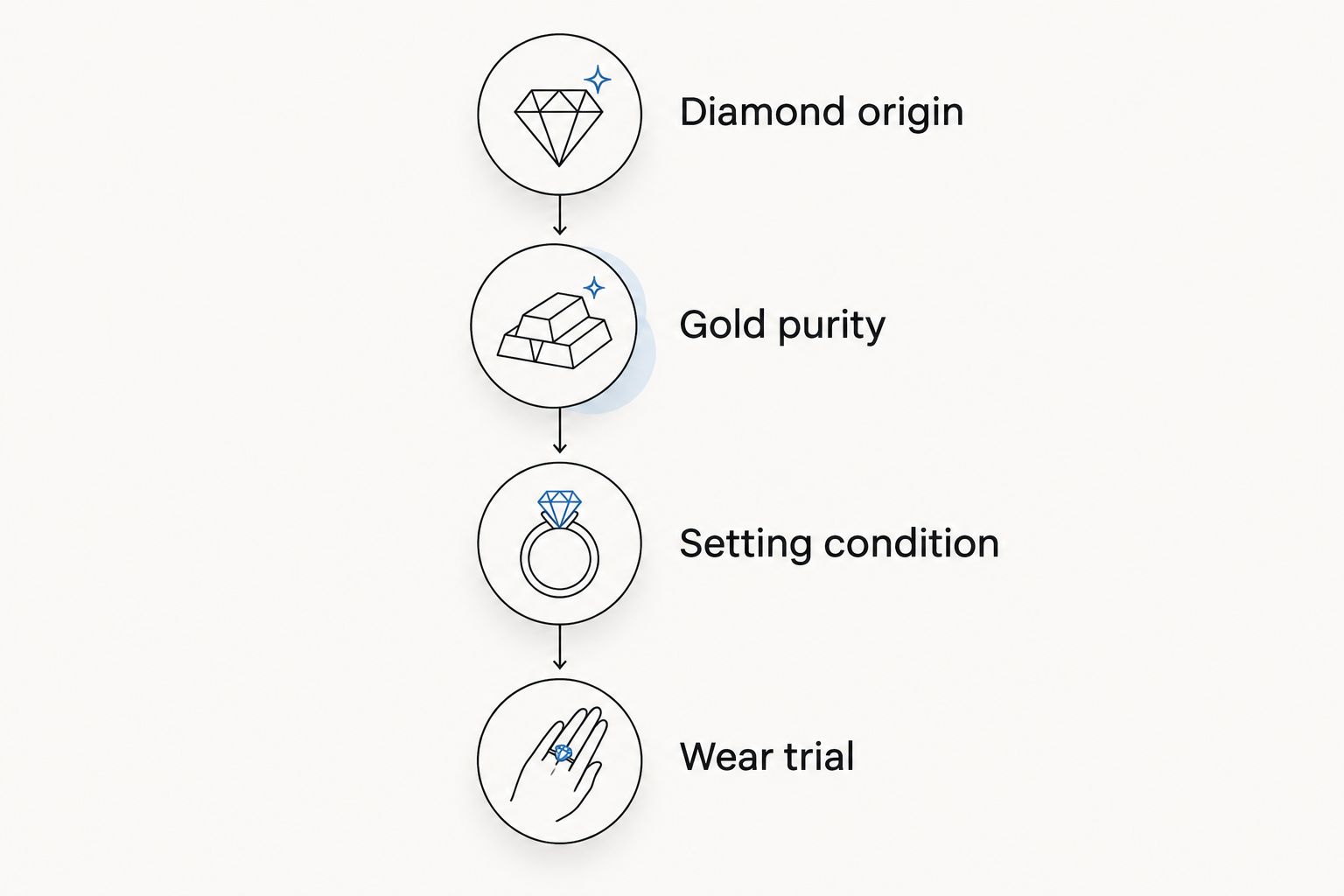
Use this sequence before approval:
- Diamond origin: Establish the lab-grown disclosure and relevant stone documentation.
- Gold purity: Check the stated alloy and applicable hallmark.
- Setting condition: Examine edges, stone security and closures.
- Wear trial: Assess fit, movement and comfort on the body.
How the ranking works
This ranking prioritises versatility, functional construction and a clear use case. Studs lead because their compact format serves an everyday wardrobe; pendants take the gifting slot because they avoid exact ring sizing. Rings, hoops, bracelets and drops follow according to their specific roles.
The ranking compares design formats, not independently tested products. The individual piece must still pass the documentation and wear checks. A well-finished lower-ranked format is a better choice for its intended wearer than an uncomfortable version of the top pick.
Which lab-grown diamond jewellery should you choose?
Choose studs if you are undecided. Select a pendant for a gift, a solitaire ring for an engagement, hoops for a stronger earring outline, a bracelet for wrist styling or drops for a planned bridal outfit.
Auramjewellery is best for bespoke jewellery buyers seeking handcrafted work. For any lab grown diamond jewellery commission, establish the intended stone origin, metal, dimensions and setting before approving the design. Handcraft and certification are relevant credentials, but neither replaces those decisions.
For a 2026 brief, describe how you will wear the piece before discussing decorative detail. Bring the neckline, hairstyle or accompanying ring into the conversation. A clear use case gives the design a practical boundary.
Explore handcrafted jewellery
Review Auramjewellery's jewellery and bespoke commissions, then clarify the diamond origin for your chosen design.
FAQ
What's the best lab grown diamond jewellery for a first purchase?
Lab-grown diamond studs are the default first purchase for everyday versatility. Check backing comfort, paired appearance and clear disclosure of diamond origin before choosing the finished pair.
Are lab-grown diamonds real diamonds?
Yes, lab-grown diamonds are diamonds, not diamond simulants such as cubic zirconia or moissanite. Their laboratory-grown origin should be disclosed clearly in the sale documentation.
Is a lab-grown diamond pendant better than a ring for gifting?
A pendant is the better choice when you do not know the recipient's ring size. You still need to establish a suitable chain length and a design that matches their neckline preferences.
Does an IGI report prove a diamond is lab-grown?
An IGI report must be read for its stated diamond origin; the presence of an IGI report alone does not establish lab-grown origin. Match its details to the diamond being sold and establish which stones it covers.
Is a gold hallmark the same as diamond certification?
No, a gold hallmark concerns the precious metal, while diamond documentation concerns the stone. Check them separately rather than treating either as proof of the whole piece's specifications.
Can I wear lab-grown diamond jewellery every day?
Everyday wear depends on the jewellery's construction, fit and your activities, not just the diamond's origin. Remove it for tasks that expose the stones or setting to knocks, abrasion or chemicals.
Should I choose Auramjewellery for a bespoke lab-grown diamond piece?
Auramjewellery offers handcrafted jewellery and bespoke commissions. Establish whether the proposed commission specifies lab-grown diamonds, then approve the stone documentation, metal and construction details before proceeding.
One last thing
Inspect the part that touches you, not just the part everyone sees. The back of a stud, underside of a ring and edge of a pendant often decide whether a beautiful piece becomes a regular companion or stays in its box. Make that inspection your final approval step.