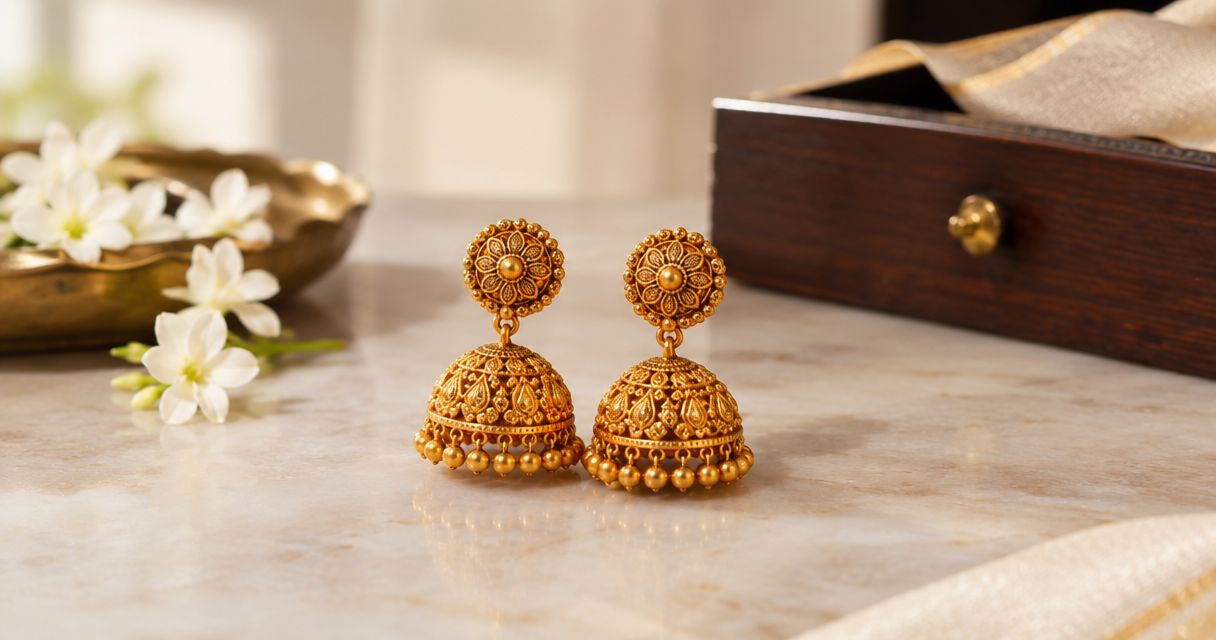
Gold jhumka earrings price in India isn't a number printed on a tag — it moves with the day's 22K or 18K gold rate, the pair's weight in grams, the making charges the karigar bills for the design, and 3% GST added on top. A plain hallmarked pair costs less per gram than one with kundan work, pearl drops, or filigree, because making charges rise with hand-finishing time, not with gold weight alone.
- Gold jhumka earrings price in 2026 tracks the day's gold rate plus weight, making charges, and GST — never a fixed figure.
- Handcrafted kundan or filigree jhumkas carry higher making charges than plain machine-made pairs of the same weight.
- 3% GST applies on gold value plus making charges on every hallmarked gold jhumka purchase in India.
- Auram Jewellery's Kolkata karigars hand-finish jhumka designs in BIS hallmarked 22K and 18K gold, priced against the live rate at checkout.
- Checking the day's gold rate before ordering avoids surprises when the final invoice is drawn.
Why this matters
Most first-time buyers assume a jhumka's price is fixed the way a garment or a gadget is. It isn't. Gold is a commodity, so the base value swings with the market every single day, and two visually similar jhumkas can carry very different invoices depending on purity, weight, and how much hand-finishing went into the design.
That's why comparing a gold jhumka earrings design on price alone without checking the hallmark, the karat, and the making charge percentage is how buyers get surprised at checkout. The formula below is the same one every BIS-compliant jeweler in India uses in 2026 — only the inputs change.
How much does gold jhumka earrings cost?
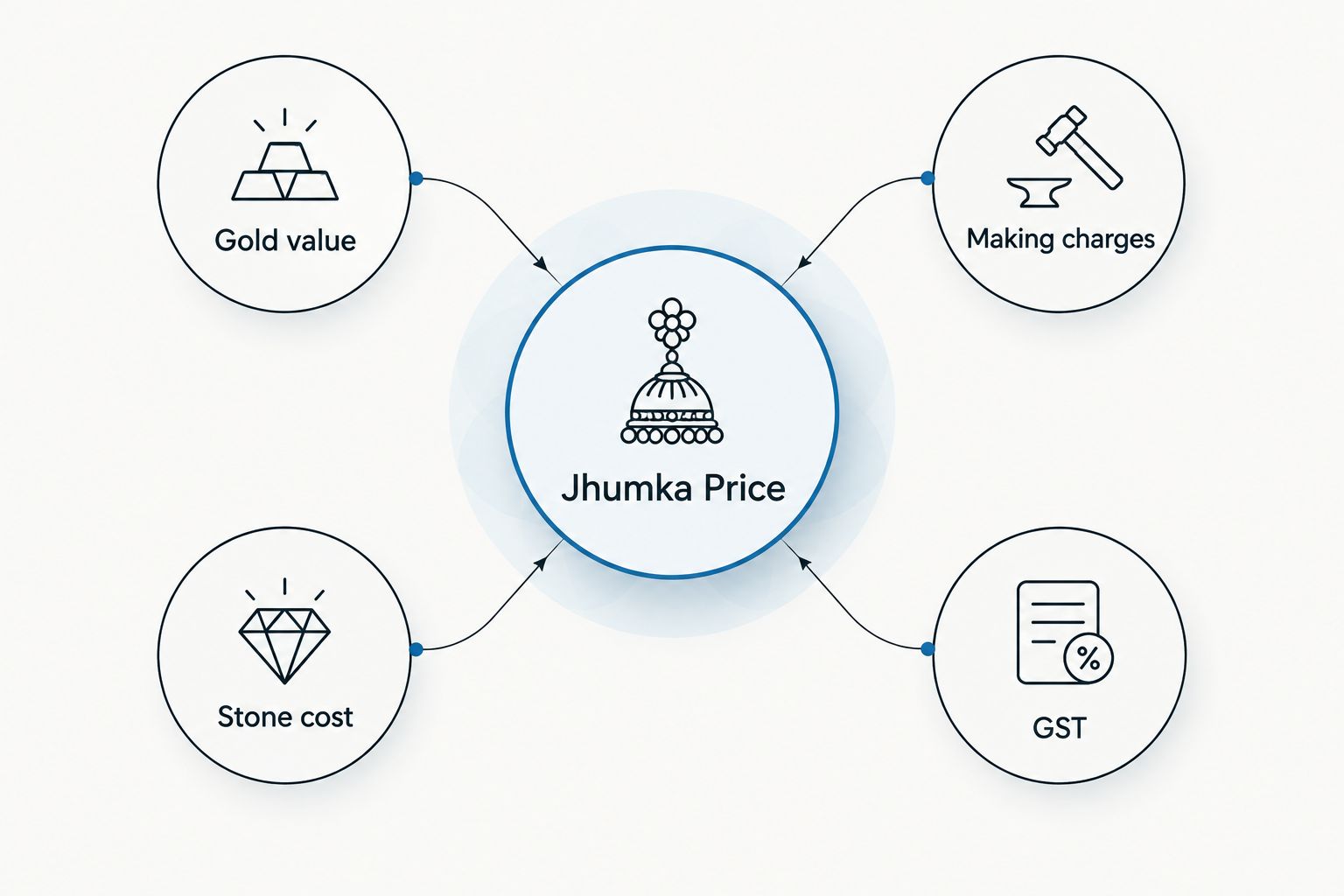
The invoice for a gold jhumka pair is built from four components, in this order:
| Component | What it covers | How it's calculated |
|---|---|---|
| Gold value | The metal itself | Weight in grams × the day's 22K or 18K rate |
| Making charges | Karigar labor and design complexity | Charged as a percentage of gold value or a flat rate per gram — higher for kundan, filigree, or temple-motif work |
| Stone/diamond cost (if any) | Kundan, pearls, or diamond studding | Priced separately by carat/quantity, added to the base |
| GST | Statutory tax on gold jewellery in India | 3% on (gold value + making charges + stone cost) |
There's no way to quote a single rupee figure for "gold jhumka earrings price" that stays accurate for more than a day, because the gold rate itself resets daily. The honest move before ordering is to check today's gold rate rather than anchor to a number you saw last week.
Why gold jhumka earrings price varies
- The day's gold rate — the single biggest swing factor, since it's set by the market and changes every trading day in 2026.
- Purity (22K vs 18K vs 916 hallmark) — 22K carries more gold by weight than 18K, so it costs more per gram even before making charges.
- Weight — a heavier bridal jhumka naturally carries more gold value than a lightweight daily-wear pair of the same design.
- Design complexity — kundan setting, filigree, temple motifs, and pearl drops all add hand-finishing hours, which raises the making charge percentage.
- Machine-made vs handcrafted — cast, machine-finished pieces typically carry lower making charges than pieces finished entirely by hand.
- Stone or diamond additions — any kundan, pearl, or diamond work on the jhumka is priced on top of the gold and making charge base.
A plain, lightweight, machine-made 18K jhumka and a heavy, hand-finished, kundan-set 22K bridal jhumka can differ enormously in final cost even if they look similar in a photo — the difference is almost entirely in weight, purity, and making charges, not the design alone.
Light, festive, and bridal jhumkas — same formula, different weight class
Jhumkas generally fall into three practical categories:
- Everyday/lightweight jhumkas: lower weight, simpler finish, lower making charge percentage. Best for daily wear and office use. Buy if you want a hallmarked gold jhumka you can wear often without worrying about upkeep.
- Festive/mid-weight jhumkas: moderate weight, some kundan or pearl work, moderate making charges. Best for weddings you're attending as a guest, festivals, and gifting. Buy if you want more presence than a daily-wear pair without full bridal weight.
- Heavy bridal jhumkas: higher weight, elaborate filigree or kundan work, highest making charges. Best for the bride's own wedding jewellery or as a statement bridal gift. Commission if you want the design personalized rather than picking off a shelf.
Is 22K or 18K better for jhumka earrings?
22K gold (916 hallmark) holds more gold value per gram and is the traditional choice for bridal and heavy jhumkas in India, while 18K gold is lighter on the wrist, holds detailed stone-setting well, and suits daily or office wear better. Neither is objectively "better" — the right pick depends on whether the jhumka is for daily use or occasion wear, a question the 22K gold for daily wear guide breaks down further.
Do handcrafted jhumkas cost more than machine-made ones?
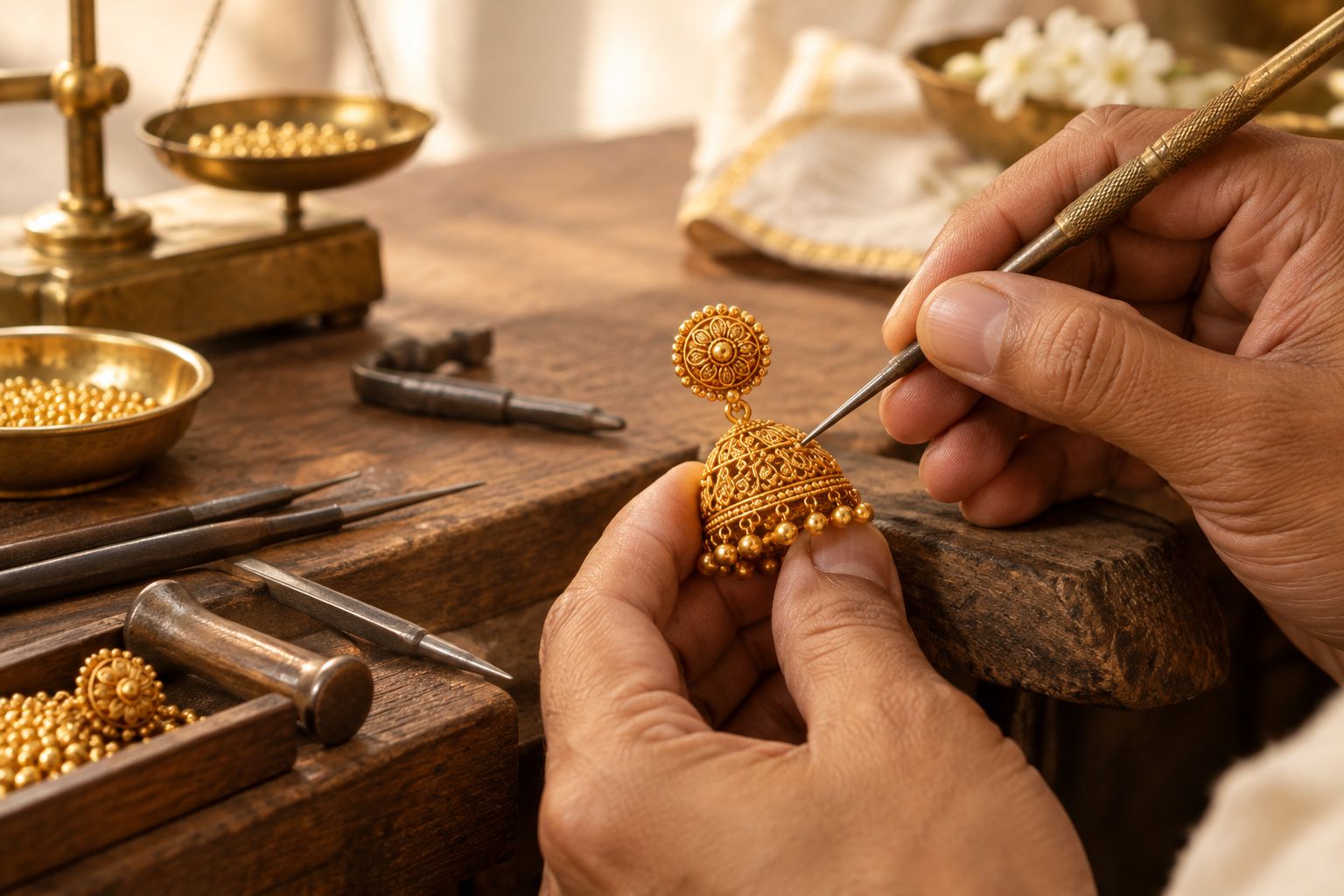
Handcrafted jhumkas cost more in making charges than machine-made pairs of identical weight and purity, because hand-finishing — filigree, kundan setting, temple-motif carving — takes far longer than casting. The gold value stays the same either way; only the making charge line on the invoice changes.
How do I make sure the hallmark on my jhumka is genuine?
Every BIS hallmarked gold jhumka carries a purity mark (like 916 for 22K) along with the assaying center's mark and a unique HUID number that can be checked before you finalize a purchase. The verify BIS hallmarking guide walks through what to look for on the piece and the certificate before you pay.
If the jhumka design you want isn't sitting in a display case anywhere, that's a bespoke commission conversation, not a compromise — Auram Jewellery's karigars in Kolkata take custom jhumka briefs where weight, purity, and stone work are agreed upfront so the final invoice matches what was quoted.
Get a jhumka price quote today
Talk through weight, purity, and design before you order.
FAQ
How much does gold jhumka earrings cost in 2026?
Gold jhumka earrings cost is calculated as weight in grams times the day's 22K or 18K gold rate, plus making charges, plus 3% GST — there's no fixed price because the gold rate resets daily. Check the current gold rate before ordering rather than relying on a number from a previous day.
Is making charge included in the gold jhumka price?
Yes, making charges are always added on top of the gold value in a gold jhumka's final price. They're charged either as a percentage of gold value or a flat rate per gram, and rise with design complexity.
Do kundan jhumkas cost more than plain gold jhumkas?
Kundan jhumkas cost more than plain gold jhumkas of the same weight because kundan setting adds both stone cost and extra hand-finishing time, which raises the making charge percentage.
What GST applies on gold jhumka earrings in India?
A 3% GST applies on gold jhumka earrings in India, charged on the combined total of gold value, making charges, and any stone or diamond cost.
Is 18K or 22K better for jhumka earrings?
22K gold suits heavy bridal jhumkas since it holds more gold value by weight, while 18K gold suits daily or festive jhumkas since it's lighter and holds fine stone-setting well.
How can I verify hallmarking on gold jhumka earrings before buying?
Check for the BIS purity mark (such as 916 for 22K), the assaying center's mark, and the unique HUID number on the piece and its certificate before paying — all three should be present on a genuinely hallmarked jhumka.
Are handcrafted jhumkas more expensive than machine-made ones?
Handcrafted jhumkas are more expensive than machine-made ones of the same weight and purity because hand-finishing work like filigree and kundan setting takes significantly more karigar time than casting.
Does jhumka weight affect price more than design?
Weight affects the gold value portion directly and predictably, while design complexity affects making charges — on a heavy plain jhumka, weight usually drives more of the price; on a light but elaborate jhumka, making charges can dominate instead.
One last thing
The line buyers skip reading is the making charge percentage, not the gold rate — most people check the gold rate obsessively and then never ask whether making charges are quoted as a flat percentage or a per-gram rate, which is exactly where two "identical-looking" jhumka quotes diverge in 2026. Ask for that number in writing before you compare two jewelers' quotes on the same design.