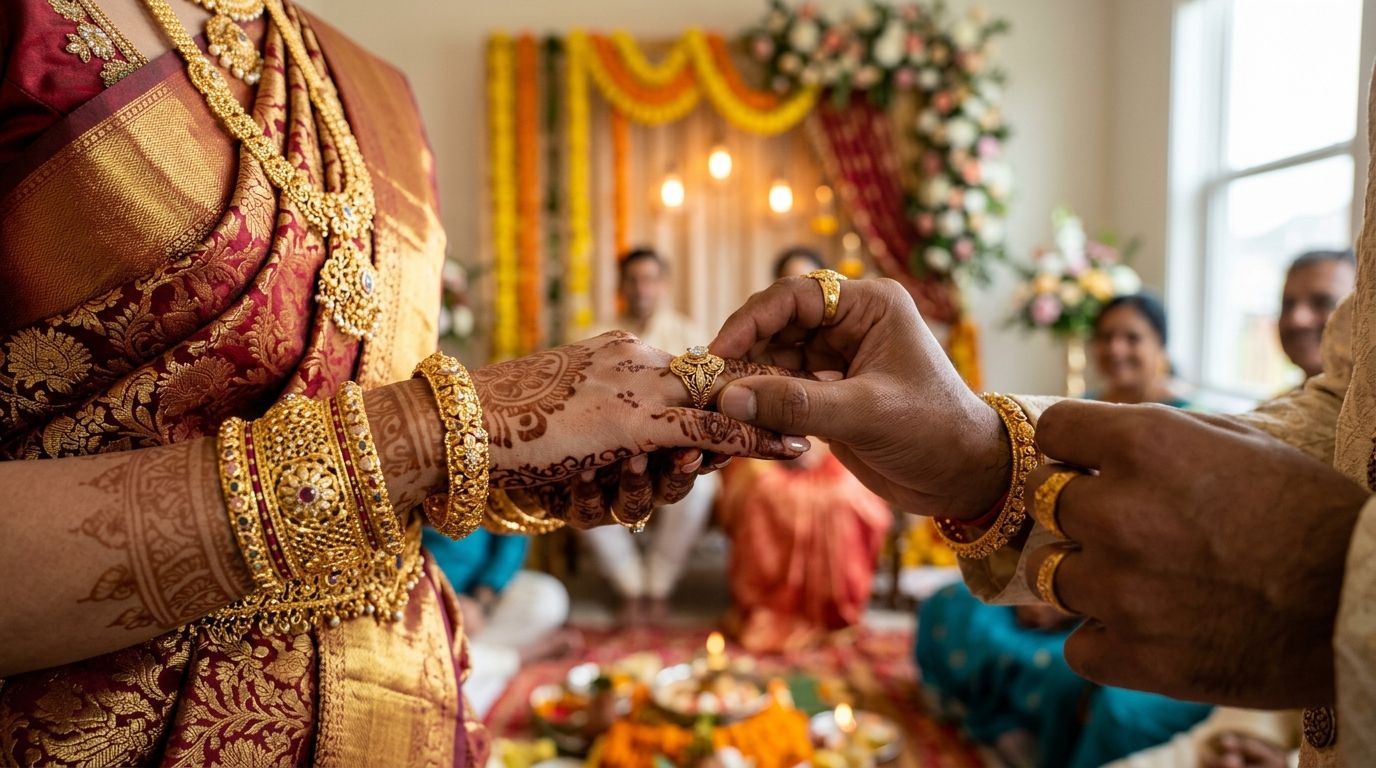
Gold jewellery for engagement ceremonies is the ceremonial ornamentation a bride and groom's families choose for the ring-exchange event, with the aim of marking the shift from courtship to marriage in front of both sides of the family. Unlike full bridal trousseau, engagement pieces are lighter, fewer in number, and built to photograph well for a single afternoon rather than carry the weight of a wedding-day look.
- Gold jewellery for engagement ceremonies should center on one hero piece — a necklace, choker, or ring set — not a full bridal load.
- 22KT (916 hallmarked) gold is the standard for engagement pieces in India in 2026; 18KT works if the piece carries stones.
- Auram Jewellery's BIS hallmarked and IGI-certified pieces let you verify purity and diamond grade before the ceremony date.
- Budget by gram weight and karat first, design second — sticker price without a weight breakdown is a red flag.
- Pick versatile designs that convert to daily or wedding wear after the event to avoid buying twice.
Why gold jewellery matters for the engagement ceremony specifically
An engagement ceremony has different constraints than a wedding: shorter guest list, indoor lighting for photos, and a bride who will likely wear the same pieces again at the reception or sangeet. That means the jewellery has to do double duty — look substantial in photos without the bulk of a full bridal set from Auram Jewellery.
Families shopping for this event also work on a compressed timeline, often 2-6 weeks before the date, which changes how much customization is realistic. A bespoke commission needs lead time; a curated ready piece does not. Knowing which route you're on before you start browsing saves a wasted showroom visit.
Building your engagement jewellery plan, step by step
Pick the hero piece before anything else
Decide whether the ring, the necklace, or a choker carries the ceremony look — trying to make every piece a showstopper is how budgets blow past plan.
- Start with the ring exchange moment: a diamond engagement ring usually anchors the photos more than any necklace does.
- If the bride already has a ring, shift the hero role to a necklace or choker set.
- Keep earrings and bangles supporting, not competing — matched sets read cleaner on camera than mixed metals.
- Confirm with both families early if there's a regional expectation (a maang tikka, a nose pin) so the hero piece doesn't clash with tradition.
Set your budget by weight and karat, not sticker price
Gold pricing moves daily in 2026, so a quoted total means nothing without the gram weight and purity behind it.
- Ask for the per-gram rate and total weight on every quote, not just a bottom-line number.
- Separate making charges from metal value — engagement pieces with intricate filigree carry higher making charges per gram.
- Budget stone-setting and diamond cost as a separate line item if the piece has embedded stones.
- Set a ceiling before you walk in; showroom lighting and pressure from staff push most buyers 15-20% over their own plan.
Match gold purity to what the ceremony calls for
22KT gold, hallmarked 916, is the standard purity for engagement jewellery across most of India in 2026 because it holds detailed karigari work without being too soft.
- Use 22KT (916) for necklaces, chokers, and bangles where craftsmanship detail matters.
- Use 18KT for stone-set rings — the added alloy gives better durability for daily wear after the ceremony.
- Avoid anything below 18KT for a piece meant to last through the marriage; it wears down faster and resells poorly.
- Ask the jeweller to explain the purity-to-durability tradeoff for your specific design before you commit.
Verify certification before you sign the bill
A hallmark and a certificate are not decoration — they're the only proof of what you're actually paying for.
- Check for the BIS hallmark stamp with the 916 purity mark on gold pieces; BIS hallmarked gold jewellery has been mandatory in India since June 2021.
- Ask for an IGI certificate on any piece with diamonds — it verifies cut, clarity, and whether stones are conflict-free.
- Match the hallmark number on the piece to the paperwork before you leave the store.
- Get the certification in writing at the time of purchase, not promised as a follow-up.
Choose designs that transition into daily or wedding wear
An engagement set worn once and locked away is a poor use of budget — the best pieces earn a second life.
- Pick a choker or necklace that pairs with both Indian and western outfits for post-ceremony events.
- Choose a ring silhouette that works for daily wear, not just a photo-ready statement piece.
- Avoid overly matched three-piece sets if you plan to mix jewellery for the wedding day itself.
- Ask whether the design can be resized or reworked later without losing stone integrity.
Time the order around the ceremony date
Engagement shopping windows run shorter than wedding shopping windows, and that changes what's realistic.
- Place orders at least 3-4 weeks out if any resizing or stone-setting is involved.
- Build in a buffer week for a fitting before the ceremony, especially for rings.
- Confirm hallmarking and certification paperwork will be ready before the date, not after.
- If the date is under two weeks away, shop from ready inventory rather than a custom order.
Consider a bespoke commission for a one-of-a-kind piece
When a family wants a design that doesn't exist off the shelf, a bespoke commission with a Master Karigar is the route — but it needs planning time the last-minute buyer doesn't have.
- Bring reference images or a family heirloom design to the first consultation.
- Confirm the karigar workflow timeline in writing before paying an advance.
- Ask whether the atelier does in-house casting and setting or outsources — it affects both timeline and quality control.
- Budget an extra 20-30% time buffer beyond the quoted delivery date for bespoke work.
Comparing your engagement jewellery options
| Option | Best for | Key limitation |
|---|---|---|
| Ready bridal gold set (22KT) | Families with under 2 weeks to the ceremony | Limited customization on stone placement |
| Diamond engagement ring | Couples who want the ring exchange as the photo moment | Resizing after the event adds a turnaround week |
| Bespoke commission with a karigar | Families wanting a one-of-a-kind heirloom-style piece | Needs 3-4+ weeks lead time minimum |
| Lightweight daily-wear gold piece | Budget-conscious buyers who want post-ceremony reuse | Less statement impact in ceremony photos |
| First-time buyer starter pieces | Buyers new to gold purchasing who want low-risk entry | Smaller design range than full bridal collections |
Verdict: for most Indian engagement ceremonies in 2026, a 22KT hallmarked necklace or choker paired with an IGI-certified diamond ring covers both the photo moment and long-term wearability — go bespoke only if the timeline allows it.
Plan your engagement jewellery order
Browse hallmarked gold and certified diamond pieces built for the ceremony and beyond.
Common mistakes engagement jewellery shoppers make
- Buying the full bridal set for a small engagement event — it overloads the photos and blows the budget meant for the wedding day.
- Skipping the hallmark check under time pressure — a rushed purchase without verifying 916 marking is the most common regret buyers report after the ceremony.
- Ignoring making charges in the quote — two pieces at the same gram weight can differ by thousands once karigari work is priced separately.
- Ordering a bespoke piece with less than two weeks to spare — karigar workflows for detailed engagement pieces don't compress well under deadline.
- Choosing a design purely for the photo and not for daily wear — a piece that only works for one event is a poor return on gold weight.
FAQ
What's the best gold purity for an engagement ceremony piece in 2026?
22KT (916 hallmarked) gold is the standard for engagement necklaces and chokers in 2026 because it balances detailed karigari work with durability. Rings with embedded stones often use 18KT for added strength.
Is a diamond ring or a gold necklace more important for an engagement ceremony?
Neither is universally more important — it depends on which moment the ceremony centers on. If the ring exchange is the photographed highlight, prioritize the ring; if a necklace or choker is worn throughout the event, prioritize that instead.
How much lead time does a bespoke engagement jewellery commission need?
Plan for at least 3-4 weeks minimum with a karigar-led atelier, plus a buffer week for fitting or resizing. Anything under two weeks should come from ready inventory instead.
Does engagement gold jewellery need a BIS hallmark?
Yes — BIS hallmarking on gold jewellery has been mandatory in India since June 2021, and it's the only reliable proof of purity at the point of sale. Always match the hallmark number on the piece to the paperwork.
Can engagement jewellery be reused for the wedding day?
Yes, if the design is chosen for versatility rather than a single photo moment. A choker or necklace that pairs with multiple outfit styles gets more use out of the same gold weight.
What's the difference between BIS hallmarking and IGI certification?
BIS hallmarking verifies gold purity (like 916 for 22KT), while IGI certification verifies diamond quality — cut, clarity, carat, and color. Engagement pieces with both metal and stones need both certifications checked separately.
Should first-time buyers start with engagement jewellery or simpler pieces?
First-time buyers often do better starting with a smaller, well-certified piece to understand purity and pricing before committing to a full engagement set. A starter piece builds comfort with hallmark checks and gram-weight quotes.
One last thing
The detail most families miss: making charges, not gold rate, are usually where two nearly identical engagement pieces diverge in price. Ask for the making-charge percentage separately from the metal cost on every quote in 2026 — it's the single fastest way to compare two showrooms fairly.