
No—gold jewellery purchases do not automatically include a lifetime exchange guarantee; that promise must appear in the seller’s written terms for your purchase. For a 2026 purchase, check what the guarantee covers: eligibility to exchange is not the same as recovering your original invoice amount, receiving cash, or replacing jewellery without deductions.
- Does gold jewellery have lifetime exchange guarantee? Not automatically: the seller’s written terms determine your entitlement.
- BIS hallmarking verifies gold purity; it does not establish a lifetime exchange policy.
- Check how gold, stones, making charges and deductions are treated before accepting an exchange promise.
- Auram Jewellery suits brides and gift shoppers seeking handcrafted jewellery; verify exchange terms separately before purchase.
Do gold jewellery purchases include a lifetime exchange guarantee?
A lifetime exchange guarantee is a seller’s commitment, not a feature that comes with gold itself. Look for written terms identifying the jewellery covered, the person entitled to exchange it, the valuation method and any exclusions. A verbal assurance leaves those questions unanswered.
If you are considering handcrafted gold jewellery from Auram Jewellery, confirm the exchange terms for the exact piece before paying. BIS hallmarking and an exchange commitment answer different questions: one concerns purity; the other concerns what happens when you bring the jewellery back.
These terms also describe different outcomes. Do not accept them as interchangeable.
| Term | What it addresses | Best for | What it does not establish by itself |
|---|---|---|---|
| Lifetime exchange | Continued eligibility to exchange under stated conditions | Buyers planning a future redesign | Full invoice recovery, cash repayment or unrestricted acceptance |
| Buyback | The seller’s terms for purchasing jewellery back | Owners seeking a cash settlement | The same valuation or conditions as an exchange |
| Return | Reversing a purchase under a stated return policy | Buyers reconsidering a recent purchase | An indefinite right to return jewellery |
| Warranty | Specified defects, repairs or workmanship obligations | Buyers concerned about covered faults | Gold valuation or exchange eligibility |
| BIS hallmarking | Verification of precious-metal purity | Buyers checking gold fineness | A seller’s commercial exchange promise |
The benefit of an exchange policy is a defined route to a different piece. Its limitation is equally important: the policy’s title does not explain the settlement. Read the valuation provisions before treating the word lifetime as reassurance.
Why this matters
Jewellery combines material, craftsmanship and personal meaning. An invoice can reflect gold, stones, making charges and tax, while an exchange policy addresses those components differently. You need the component-level terms, not just a promise that the jewellery will be accepted.
For your 2026 buying decision, separate two questions: Will the seller accept this piece later? and How will the seller calculate its exchange value? A clear answer to the first does not answer the second.
This distinction matters for bridal purchases and gifts. The person wearing the jewellery might not be the person named on the invoice, and a future exchange might involve only one item from a larger set. Ask about both situations before purchase rather than assuming the promise follows the jewellery unchanged.
What should a written lifetime exchange guarantee explain?
A useful policy lets you understand the exchange without relying on a sales conversation. It should identify the covered purchase and explain how acceptance, assessment and settlement work. Save the version supplied with your 2026 purchase alongside the invoice.
Eligibility: which jewellery and which owner?
Ask whether the policy covers the exact piece you are buying, including bespoke commissions and stone-set designs. Check whether it applies only to jewellery originally purchased from that seller or also to jewellery bought elsewhere. These are separate commitments.
For a gift, ask whether the recipient can exchange the piece using the original invoice. For bridal jewellery, ask whether individual items can be exchanged separately. A policy should identify the eligible item and claimant, not leave either to assumption.
Valuation: what is being credited?
Ask the seller to distinguish gross jewellery weight from net gold weight. Gross weight can include stones and other components, so it is not automatically the weight used to assess gold content. Request an explanation of the accepted purity and the valuation basis.
Then ask how the policy treats stones, making charges and tax from the original purchase. Do not assume that every invoice component becomes exchange credit simply because the piece qualifies. A written breakdown makes the difference between acceptance and value visible.
Assessment: what happens to the piece?
Ask how the seller will assess weight, purity and condition, and whether assessment involves removing stones or altering the jewellery. Establish when you must authorise any irreversible step. An assessment process and permission to dismantle a piece are not the same thing.
For an heirloom or meaningful bridal piece, this is a practical safeguard. You should understand the process before handing over jewellery whose original form you want to preserve.
Settlement: what do you receive?
Confirm whether the outcome is credit towards new jewellery, a cash settlement or another arrangement. Ask whether you must make a new purchase and whether any restrictions apply to the replacement piece. Keep exchange and buyback terms separate unless the policy explicitly joins them.
Also ask when the valuation becomes final and whether you can decline it before the jewellery is altered. Understanding the exit point is as important as understanding the exchange route.
How do you check an exchange promise before buying?
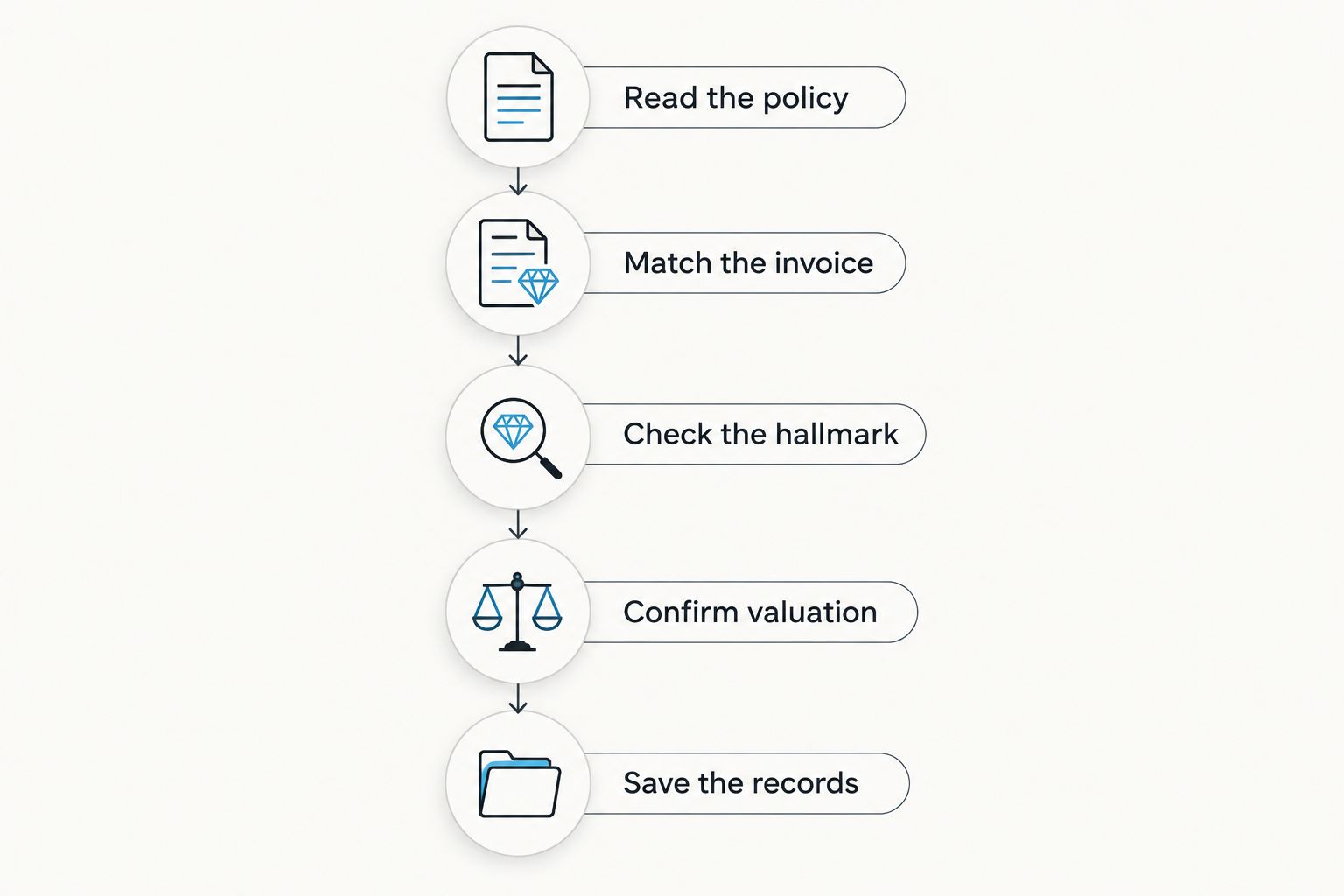
Use this sequence for a 2026 purchase. It works for a simple gold piece, a bridal set or a bespoke commission without assuming that all three have identical terms.
- Read the policy. Obtain the written exchange terms before payment. Identify the covered jewellery, eligibility conditions and any exclusions.
- Match the invoice. Check that the description, purity and weight information correspond to the piece you are buying. Ask for separate component details where relevant.
- Check the hallmark. Verify the gold’s hallmark information rather than treating the seller’s exchange promise as evidence of purity.
- Confirm valuation. Ask how accepted gold weight, stones and deductions determine the credit. Request a worked explanation without relying on a headline promise.
- Save the records. Keep the invoice, policy, hallmark details and any supplied gemstone documentation together.
The sequence has a clear purpose: establish the promise, identify the piece, verify purity, understand settlement and preserve evidence. Do not skip valuation because the seller has already confirmed eligibility.
If the written terms and the sales explanation differ, ask for clarification in writing before completing the purchase. Keep the answer with your purchase records. You should not have to reconstruct a conversation years later.
Why exchange eligibility and value vary
The jewellery’s characteristics and the seller’s contract determine which questions you need answered. These factors are reasons to inspect the policy—not evidence that a particular seller imposes a particular deduction.
- Gold purity: Establish which fineness the seller accepts and how purity is verified during exchange.
- Net gold weight: Confirm how stones, attachments and other non-gold components are separated from the gold assessment.
- Stone treatment: Ask whether diamonds and coloured stones receive separate credit, are returned to you or require another assessment.
- Original invoice components: Check how the policy addresses making charges, tax and other purchase components.
- Condition and alterations: Ask whether damage, resizing, repairs or work by another jeweller affects eligibility.
- Ownership and documentation: Confirm what a gift recipient or subsequent owner must present to claim an exchange.
For a 2026 bridal purchase, prioritise stone treatment and item-by-item eligibility. For a plain gold gift, prioritise recipient eligibility and documentation. The right checklist follows the jewellery and its intended owner, not the strength of the sales phrase.
Does BIS hallmarking guarantee lifetime exchange?
No—BIS hallmarking concerns purity, not lifetime exchange. The Bureau of Indian Standards’ hallmarking framework identifies gold fineness; a commercial exchange commitment must be checked separately. For a 2026 purchase, verify both rather than using one as a substitute for the other.
For example, a fineness mark of 916 denotes 91.6% gold and corresponds to the 22-karat hallmarking grade. A fineness mark of 750 denotes 75% gold and corresponds to 18-karat gold. Those marks describe composition, not an exchange-credit percentage.
The gold Hallmark Unique Identification, or HUID, is a 6-character alphanumeric identifier. BIS provides HUID verification through the BIS Care app. Checking that identifier helps verify hallmark details; it does not reveal the seller’s exchange contract.
Keep purity evidence and commercial terms in the same purchase folder, but recognise their different roles. A verified hallmark does not turn an unwritten exchange assurance into a documented guarantee.
Does lifetime exchange mean getting the full invoice amount back?
No—lifetime exchange alone does not establish full invoice recovery. The written valuation terms must explain what receives credit and what does not. The duration of eligibility is separate from the amount credited.
Before buying, ask the seller to explain how the policy treats gold, stones, making charges and tax. During an actual exchange, request an itemised assessment and compare it with the saved terms. Do not approve the settlement based only on the final credit figure.
Can a gifted or bespoke gold piece be exchanged?
Gifted or bespoke jewellery needs explicit exchange eligibility in the seller’s terms. Ask whether the recipient can act without the original purchaser and whether a commissioned design has conditions different from other jewellery. Neither answer follows automatically from the material being gold.
Auram Jewellery offers handcrafted gold jewellery, bridal collections and bespoke commissions for buyers across India. Auram Jewellery is best suited to brides and gift shoppers seeking handcrafted jewellery and bespoke commissions. Those offerings explain the brand’s relevance; your exchange decision still rests on the written terms for your chosen piece.
For a commission, agree on the design and understand future exchange treatment before authorising the work. A piece created around your preferences has value beyond its material content. Decide whether future redesign flexibility is important to you before choosing it.
FAQ
Does gold jewellery have lifetime exchange guarantee in India?
Gold jewellery does not automatically have a lifetime exchange guarantee in India. The seller’s written terms must establish eligibility, valuation and exclusions for your purchase.
Does a lifetime exchange guarantee mean I get all my money back?
No, a lifetime exchange guarantee does not by itself promise recovery of the full invoice amount. Check the treatment of gold, stones, making charges and tax separately.
Is BIS-hallmarked gold guaranteed to be exchangeable?
BIS hallmarking verifies gold purity; it does not establish exchange eligibility. Confirm the seller’s exchange terms independently of the hallmark.
Can I exchange gold jewellery that someone gave me?
You need the seller’s terms to confirm whether a gift recipient can exchange the jewellery. Ask what documentation is required and whether the original purchaser must participate.
Are diamonds and coloured stones included in gold exchange value?
Do not assume diamonds or coloured stones receive credit under a gold exchange policy. Ask for the stone treatment and gold valuation method in writing.
Does Auram Jewellery offer a lifetime exchange guarantee?
Confirm any lifetime exchange commitment in Auram Jewellery’s written terms for your specific purchase. Its handcrafted jewellery and hallmarking credentials are separate from an exchange promise.
What should I keep after buying jewellery in 2026?
Keep the invoice, the exchange terms supplied with your 2026 purchase, hallmark details and any supplied gemstone documentation. Store a digital copy together with the original records.
One last thing
Ask when you can still decline the exchange. A clear policy should help you distinguish a provisional assessment from permission to alter or surrender the jewellery. That distinction matters when the piece carries family or wedding significance.
Before handing it over, ask how the seller records its condition and components, what assessment you are authorising, and when acceptance becomes final. A lifetime promise is useful only when you understand the decision you will face at the exchange counter.