Best overall: a plain gold interlocking-ring trinity necklace. Best for anniversary gifting: a mixed-tone ring design; best for a silver jewellery wardrobe: a sterling-silver interlocking pendant. This 2026 guide compares six design directions by shape, wearability and meaning, with Auram Jewellery as a bespoke commissioning option for brides and gift shoppers.
- A plain gold interlocking-ring trinity necklace is the default choice for an understated pendant.
- Mixed-tone rings suit anniversary gifting; a triquetra suits buyers who specifically want a knot motif.
- Choose a fixed-ring pendant when keeping the three circles aligned matters more than movement.
- Auram Jewellery suits brides and gift shoppers seeking handcrafted jewellery and bespoke commissions.
Why this matters
A trinity necklace is not one fixed design. The term can describe three interlocking rings, a three-part pendant or a triquetra knot, and those shapes look different when worn.
Choose the silhouette before choosing the metal. An articulated ring pendant changes position as you move; a fixed arrangement keeps its outline. A triquetra replaces separate circles with a continuous knot motif.
For a 2026 purchase, start with the recipient's existing jewellery rather than the symbolism alone. Someone who wears simple chains needs a different pendant from someone who wants a defined motif for an occasion.
What makes the best trinity necklace?
Use these criteria to judge the finished necklace, not just its front-facing photograph:
- Readable shape: You should recognise the three-part design without needing to rearrange the pendant.
- Controlled movement: Decide whether the rings should move independently or remain fixed together.
- Comfortable construction: Inspect the reverse, connecting points and pendant loop for rough edges or awkward contact.
- Chain compatibility: Check that the chain passes through the pendant correctly and supports its intended position.
- Documented material: Confirm gold fineness, silver purity and any diamond documentation for the actual piece.
- Personal relevance: Choose a motif the wearer likes; do not assume everyone assigns the same meaning to it.
A photograph answers the first criterion. A side view, reverse view and demonstration on the intended chain answer much more of the rest.
Trinity necklace designs at a glance
| Rank and design | Best for | Standout feature | Key limitation |
|---|---|---|---|
| 1. Plain gold interlocking rings | An understated default | Three moving circles without stone decoration | Rings overlap and change position |
| 2. Mixed-tone interlocking rings | Anniversary gifting | Colour distinguishes the individual rings | Colour alone does not identify metal composition |
| 3. Fixed three-ring pendant | A consistently aligned silhouette | A stable, deliberate arrangement | Less movement than articulated rings |
| 4. Diamond-accent trinity pendant | Occasion dressing | Stone detail adds a separate visual focus | Settings need inspection and suitable care |
| 5. Triquetra knot pendant | Intentional symbolic jewellery | A continuous three-lobed knot | Not the same shape as three interlocking circles |
| 6. Sterling-silver interlocking rings | A silver-led jewellery wardrobe | A white-metal interpretation of the ring motif | Silver tarnishes and needs appropriate cleaning |
The ranking separates use cases rather than treating decoration as an automatic improvement. Plain rings take the default slot; each later design solves a more specific preference.
1. Plain gold interlocking rings: best trinity necklace for simplicity
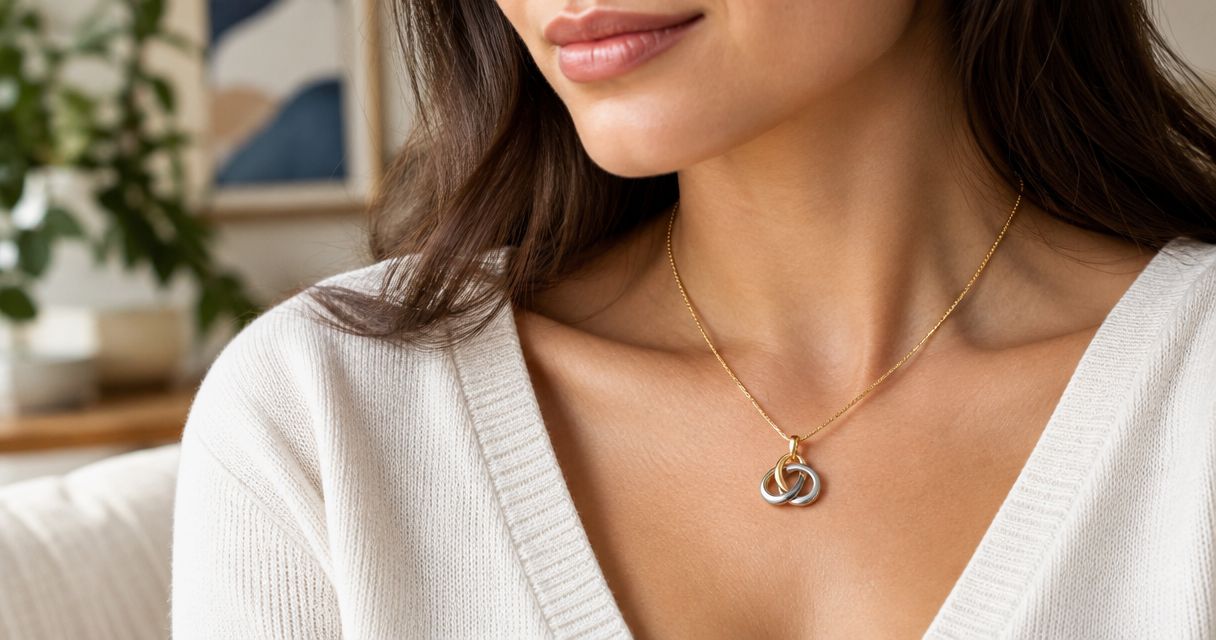
A plain gold interlocking-ring trinity necklace puts the structure ahead of decoration. Three linked circles create the pendant, while the chain and connecting loop determine how those circles hang.
Choose this design when you want the necklace to sit alongside other jewellery without introducing another stone colour. For a bespoke brief, describe whether you want equal rings, visible overlap or a particular resting arrangement; those are separate decisions.
Plain gold interlocking rings pros:
- The undecorated outline keeps attention on the linked circles.
- A single metal colour simplifies coordination with existing jewellery.
- The design leaves room to discuss proportion without adding embellishment.
Plain gold interlocking rings cons:
- Moving rings do not keep one permanent arrangement.
- Overlap can hide part of the three-ring silhouette.
- The connecting loop can dominate if its proportion is wrong.
Best for: Someone who wants one restrained pendant rather than an occasion-specific centrepiece.
Auram Jewellery offers handcrafted gold jewellery and bespoke commissions. Use this trinity necklace design as a commissioning brief, then confirm the proposed construction and metal specification before approving it.
Verdict: Buy the plain-ring design if simplicity is your priority; hold until you have seen how the rings hang.
2. Mixed-tone interlocking rings: best trinity necklace for anniversary gifting
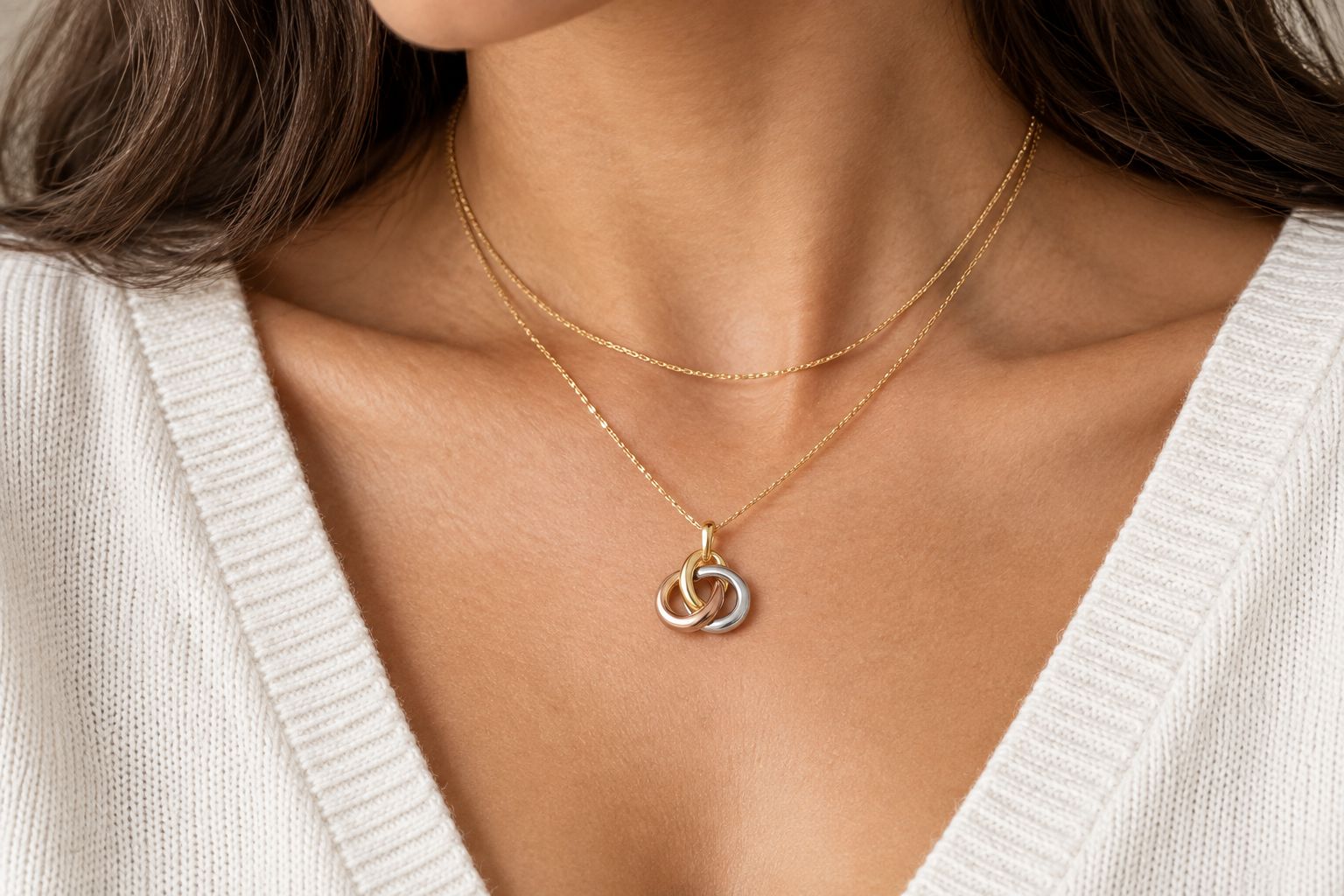
A mixed-tone trinity necklace distinguishes its rings through colour rather than extra decoration. Yellow, white and rose tones are a familiar jewellery combination, but the appearance does not establish whether a component is solid gold, plated or another metal.
For an anniversary gift in 2026, this design lets you give each ring a personal meaning without adding a visible inscription. Explain that meaning in your gift message rather than presenting it as a universal definition of the motif.
Mixed-tone interlocking rings pros:
- Different colours make the individual rings easier to distinguish.
- The design provides a connection to mixed-metal styling.
- Personal symbolism can remain separate from the visible design.
Mixed-tone interlocking rings cons:
- Surface colour is not proof of metal composition.
- Contrasting rings create a busier effect than a single-tone pendant.
- The wearer might prefer all jewellery in one metal colour.
Best for: An anniversary recipient who already combines metal colours.
Ask for a written description of every component, including its fineness and any surface treatment. Do not treat three colours as three independently verified materials.
Verdict: Buy for a mixed-metal wearer; skip if the recipient consistently chooses one metal colour.
3. Fixed three-ring pendant: best trinity necklace for alignment
A fixed three-ring pendant holds the circles in a planned arrangement rather than allowing each ring to rotate independently. The result is a more predictable outline, provided the chain and attachment points support that arrangement.
This is the better design brief when your priority is seeing all three circles at once. Ask to see the back: the front view does not reveal how the rings connect or where those connections sit against your skin.
Fixed three-ring pendant pros:
- The ring arrangement stays deliberate rather than changing freely.
- The design can preserve a clear view of all three circles.
- Its shape is easier to assess as a single composition.
Fixed three-ring pendant cons:
- It loses the independent movement of interlocking rings.
- Connecting points can complicate the reverse of the pendant.
- A fixed outline still needs checking for tipping on the chain.
Best for: Someone who wants a recognisable, consistently arranged three-circle motif.
Verdict: Buy for alignment; skip if the movement of separate rings is what attracts you to a trinity necklace.
4. Diamond-accent trinity pendant: best trinity necklace for occasions
A diamond-accent trinity pendant adds stone detail to the three-part design. The placement matters: an accent on one ring creates a focal point, while decoration across the entire pendant changes the balance between the stones and the underlying shape.
For occasion jewellery in 2026, choose the stone layout alongside your earrings. Two competing focal points can make the outfit feel less settled; the pendant does not need to repeat every detail of the rest of your jewellery.
Diamond-accent trinity pendant pros:
- Stone placement gives the design a distinct focal point.
- Selective accents can leave the three-part outline visible.
- The pendant provides an alternative to a completely plain motif.
Diamond-accent trinity pendant cons:
- Settings introduce additional details to inspect and clean.
- Raised settings need checking against clothing and hair.
- Heavy decoration can obscure the ring structure.
Best for: Someone choosing a pendant specifically for celebrations or dressed-up occasions.
Auram Jewellery sells IGI-certified diamond jewellery. For any proposed trinity commission, ask which diamond documentation applies to the actual design rather than assuming a general credential describes every component.
Verdict: Buy for deliberate occasion styling; hold until the settings and applicable documentation are clear.
5. Triquetra knot pendant: best trinity necklace for a defined motif
A triquetra pendant uses a three-lobed knot rather than three separate circular rings. That distinction matters when searching: a photograph of interlocking circles is not a substitute for the knot silhouette you intended to buy.
The triquetra appears in different cultural and religious contexts. For a personal gift, ask whether the recipient wants that motif; do not assign a religious interpretation on their behalf.
Triquetra knot pendant pros:
- The continuous outline creates a clearly different silhouette.
- It suits buyers who specifically want a knot rather than circles.
- An open design makes the negative space part of the composition.
Triquetra knot pendant cons:
- It does not reproduce the appearance of interlocking rings.
- Pointed ends need checking for comfortable finishing.
- The motif can carry associations the recipient does not intend.
Best for: A buyer with a specific preference for the triquetra shape.
Verdict: Buy when the knot itself is the reason for choosing the necklace; skip as a substitute for a ring design.
6. Sterling-silver interlocking rings: best trinity necklace for silver styling
A sterling-silver interlocking pendant translates the three-circle motif into a white-metal design. Sterling silver contains 925 parts silver per 1,000 parts alloy, equivalent to 92.5% silver; that specification concerns composition, not the quality of the finished construction.
Choose this design because the wearer prefers silver, not because colour alone proves purity. Inspect the pendant and chain separately, and ask how their material specifications are documented.
Sterling-silver interlocking rings pros:
- The white-metal appearance fits a silver-led jewellery wardrobe.
- Plain rings keep the focus on the linked shape.
- The design offers the circle motif without yellow-gold colour.
Sterling-silver interlocking rings cons:
- Silver tarnishes and requires suitable care.
- A bright white finish does not prove sterling composition.
- Cleaning instructions differ when stones or surface treatments are present.
Best for: Someone who already wears and cares for silver jewellery.
Verdict: Buy for a silver preference; hold until the pendant and chain specifications are confirmed.
Check fit before approving the necklace
For your 2026 shortlist, compare chain positions rather than choosing a length from a product photograph. Try a 40 cm, 45 cm and 50 cm cord against the neckline you intend to wear; these are fitting references, not promised product dimensions.
The pendant adds its own drop below the chain. Test the intended position while sitting and moving, and check whether the motif disappears under a collar or catches the edge of a neckline.
For gold, 18KT means 18 parts gold in 24, or 75% gold; 22KT means 22 parts in 24, approximately 91.6%. These are fineness definitions, not a reason to choose a necklace without assessing its construction.
A useful bespoke brief covers four decisions: the motif, the ring arrangement, the material and the intended wearing position. The guide to commissioning a custom bridal jewellery design gives you a related starting point for organising those choices.
Explore a bespoke jewellery brief
Choose your motif, material and wearing position before discussing a commission.
How the designs are ranked
The 2026 ranking prioritises a readable silhouette, manageable movement and a clear use case. Plain gold rings take the default position because they keep the design focused on the motif; the remaining options answer specific preferences for colour, alignment, stones, symbolism or silver.
This is a design ranking, not a claim that one material or decoration suits everyone. Your inspection of the finished necklace determines whether a particular execution deserves the recommendation.
Which trinity necklace should you choose?
Choose plain gold interlocking rings if you are undecided. Move to mixed tones for a recipient who combines colours, fixed rings for alignment, diamond accents for occasion dressing, a triquetra for the knot motif, or sterling silver for a silver-led wardrobe.
Auram Jewellery is a bespoke jewellery option for brides and gift shoppers who want to discuss a personal design. Bring a precise brief, and approve the proposed trinity necklace only after confirming its materials, reverse construction and intended fit.
FAQ
What's the best trinity necklace design in 2026?
A plain gold interlocking-ring trinity necklace is the default recommendation for an understated pendant. Choose a different design when you specifically want mixed colours, fixed alignment, diamond accents or a knot motif.
What does a trinity necklace mean?
A trinity necklace does not have one universal meaning. Three linked elements can carry a personal interpretation, while a triquetra has associations across different cultural and religious contexts.
Is a trinity necklace the same as a triquetra necklace?
No, three interlocking circles and a triquetra are different shapes. A triquetra uses a three-lobed knot, so confirm the actual silhouette rather than relying on the listing name.
Are fixed rings better than moving rings on a trinity necklace?
Fixed rings are better when you want a consistent arrangement; moving rings are better when you prefer articulation. Inspect either design on its intended chain because the attachment affects how the pendant hangs.
Does a three-colour trinity necklace contain three kinds of gold?
Three colours do not establish the necklace's metal composition. Request the fineness and surface-treatment details for each component rather than judging by appearance.
How do I choose the chain length for a trinity pendant?
Choose the chain length by testing the pendant's position against your intended neckline. Include the pendant's own drop, and check the result while sitting and moving.
Can I discuss a bespoke trinity necklace with Auram Jewellery?
Auram Jewellery offers bespoke jewellery commissions. Bring your preferred motif, metal and wearing position, then confirm whether the proposed trinity design can be made before approving the commission.
One last thing
Ask to see the necklace from the back before approving the front. The reverse reveals the connecting points, finishing and chain route that a polished front photograph leaves out. For a trinity necklace, those details determine whether the motif hangs as you intended.