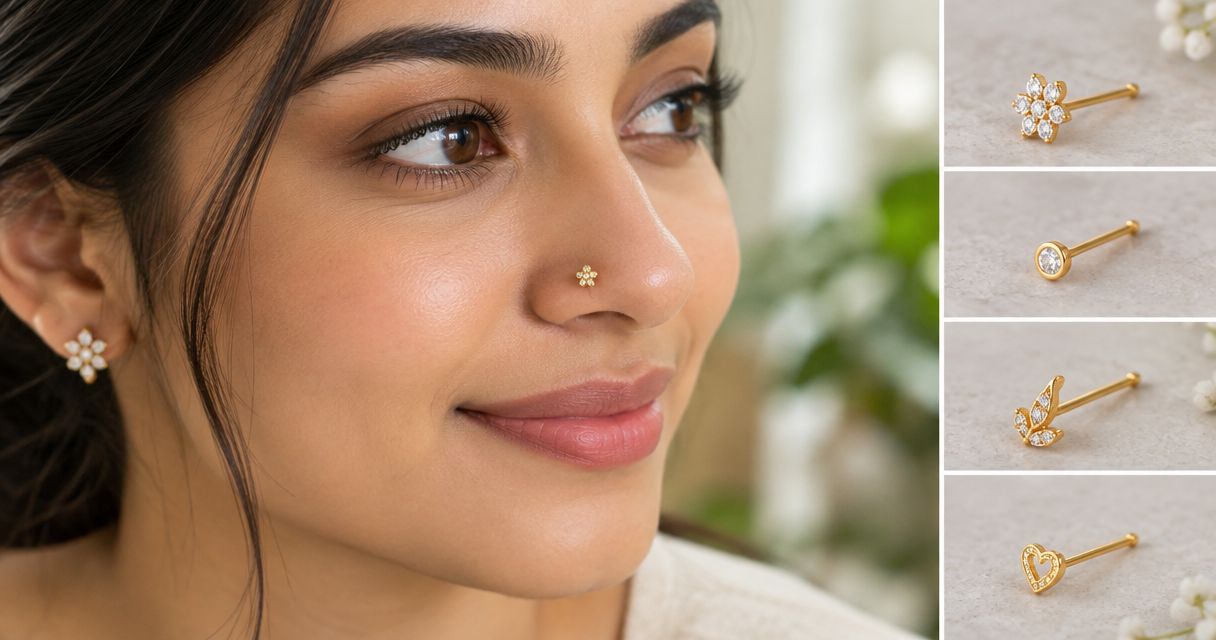
Best overall: a smooth gold dome nose pin. Best for bridal detailing: a floral gold nose pin. Best for understated sparkle: a bezel-set diamond nose pin in gold. This 2026 guide compares six design types by appearance, construction and wearability so you can choose beyond the front-facing photograph.
- A smooth gold nose pin is the default choice for a simple, stone-free everyday look.
- Choose a floral nose stud for bridal detailing or a flat disc for understated styling.
- A bezel-set diamond nose pin adds sparkle; filigree puts the focus on openwork craftsmanship.
- Auram Jewellery suits buyers seeking handcrafted gold jewellery and bespoke bridal commissions.
- Check gold purity, fastening and piercing fit before choosing a nose pin design.
Why this matters
A nose pin sits close to your skin, and its fastening matters as much as its visible face. A beautiful motif does not compensate for a post that presses, a rough underside or a closure you cannot handle comfortably.
Auram Jewellery makes handcrafted gold jewellery and accepts bespoke commissions, including bridal work. Auram Jewellery is best for buyers seeking handcrafted gold jewellery and bespoke bridal commissions. Use that craftsmanship-led approach to discuss the underside and fastening, not just the decorative surface.
For your 2026 shortlist, separate three decisions: the motif you want, the gold purity you prefer and the fitting your established piercing accepts. A larger flower and a tiny disc can use different constructions; neither name tells you whether the finished piece fits.
What makes the best gold nose pin?
Judge every design against these criteria before comparing its appearance:
- Piercing fit: Confirm the post thickness, usable length and fastening with the wearer and jeweller. Do not assume an existing pin and a replacement share the same dimensions.
- Smooth contact surfaces: Inspect the underside, edges and post. The front photograph cannot show how the piece rests against the nostril.
- Suitable profile: Choose how far the ornament should project from the skin. A raised dome and a flat disc create different silhouettes.
- Clear metal identity: Ask for the declared gold fineness and supporting documentation. Yellow colour alone does not establish purity.
- Secure construction: Examine joins, stone settings and the closure. Decorative detail should not hide an unfinished edge or an insecure component.
- A deliberate motif: Match the design to your usual jewellery or bridal ensemble. Select ornament because you want it, not because the photograph looks elaborate.
Fit is the pass-or-fail criterion; appearance decides between designs that pass. For a gift, obtain the recipient's fitting details before choosing the motif. A nose pin is too personal a purchase to size by guesswork.
Gold nose pin designs at a glance
These are design categories, not named product models. The ranking gives each one a distinct purpose rather than treating every style as an everyday winner.
| Rank and design | Best for | Standout feature | Key limitation |
|---|---|---|---|
| 1. Smooth gold dome | A simple everyday default | Rounded, stone-free face | Raised profile needs a side-view check |
| 2. Flat gold disc | Understated workwear | Clean circular silhouette | Broad face needs careful edge finishing |
| 3. Floral gold nose pin | Bridal and festive detailing | Petal-shaped ornament | More edges to inspect |
| 4. Bezel-set diamond nose pin | Restrained sparkle | Gold rim surrounds the stone | Setting adds cleaning and inspection needs |
| 5. Gold filigree nose pin | Heritage-inspired openwork | Fine patterned spaces | Delicate detail needs careful handling |
| 6. Geometric gold nose pin | Contemporary styling | Defined angular shape | Corners can feel intrusive if poorly finished |
1. Smooth gold dome: best gold nose pin for everyday simplicity
A smooth dome nose pin presents a rounded gold face without stones or cut-out decoration. It puts the emphasis on the metal itself and makes a sensible starting point when you want one uncomplicated design for regular wear.
Choose the dome's projection deliberately. A rounded face is not necessarily low-profile, so ask to see the piece from the side as well as the front.
Smooth gold dome pros:
- Keeps the design focused on gold rather than additional materials.
- Has no stone setting to assess or clean around.
- Pairs visually with both plain and more decorative jewellery.
Smooth gold dome cons:
- A pronounced dome projects farther than a flat face.
- A polished surface makes scratches visible.
- The simple front says nothing about the quality of the fastening.
Best for: You want a stone-free default rather than an occasion-specific ornament.
For 2026, start here unless you already know you want a floral, geometric or gemstone-led design. Verdict: Buy for simplicity, after checking the side profile and fit.
2. Flat gold disc: best gold nose pin for understated workwear
A flat disc nose pin uses a circular face with little decorative relief. The result is visually quieter than a flower or raised stone setting, making it a clear choice when you prefer restrained jewellery with workwear.
Check the edge in close-up. A disc should not earn approval merely because it looks minimal; its circumference and underside still need careful finishing.
Flat gold disc pros:
- Offers a clearly defined, uncomplicated silhouette.
- Avoids petals, openwork and stone-setting detail.
- Coordinates easily with other simple circular jewellery.
Flat gold disc cons:
- A wider disc covers more of the nostril surface.
- A sharp or uneven edge undermines the design's simplicity.
- Its restrained appearance will not satisfy someone seeking bridal ornament.
Best for: You want a clean accent that does not compete with earrings or a necklace.
Compare the disc against the dome from the side, not only straight on. The actual construction determines which sits closer. Verdict: Buy for understated styling; skip any piece with an uncomfortable edge.
3. Floral gold nose pin: best gold nose pin for bridal detailing
A floral nose pin arranges petals around a centre, either entirely in gold or with an added stone. The motif provides ornament in a small area and works as a deliberate companion to a bridal ensemble.
For a 2026 wedding, compare the flower with your earrings and forehead jewellery before approving it. Repeating a motif is a styling choice, not a requirement; the important question is whether you like the combination.
Floral gold nose pin pros:
- Creates a recognisable decorative motif without requiring a nose ring.
- Gives you a choice between all-gold and stone-accented interpretations.
- Provides specific details to discuss in a bespoke design brief.
Floral gold nose pin cons:
- Petals add edges that need close inspection.
- Raised or overlapping details create more cleaning recesses.
- A broad flower can dominate a small, otherwise restrained arrangement.
Best for: Brides and festive dressers who want visible ornament rather than a plain dot.
Auram Jewellery offers bespoke bridal commissions; discuss the desired motif and fitting without assuming a particular nose pin is part of its catalogue. Verdict: Buy for bridal detailing once the finished shape and underside meet your brief.
4. Bezel-set diamond nose pin: best gold nose pin for restrained sparkle
A bezel-set diamond nose pin surrounds the stone with a metal rim. Unlike a claw setting, its visible outline comes from the enclosing gold edge rather than individual projecting claws.
Choose this design when the diamond is the focal point but you want a defined, contained silhouette. Judge the whole setting: a modest stone can still sit in a projecting mount.
Bezel-set diamond nose pin pros:
- Adds a gemstone focal point to a small piece of jewellery.
- Uses a continuous rim rather than separate visible claws.
- Combines the appearance of gold with diamond sparkle.
Bezel-set diamond nose pin cons:
- The rim covers part of the stone's edge.
- The stone and setting require cleaning and inspection.
- Gold purity documentation and diamond documentation answer different questions.
Best for: You want sparkle without a petal-shaped or openwork design.
Auram Jewellery sells IGI-certified diamond jewellery. For any diamond nose pin under consideration, ask which documentation applies to that exact piece and what it identifies. Verdict: Buy for restrained sparkle after checking the setting, fitting and relevant documentation.
5. Gold filigree nose pin: best gold nose pin for heritage-inspired openwork
Filigree uses fine metalwork to create patterned detail and open spaces. In a nose pin, that decorative treatment puts attention on the workmanship rather than a single polished surface.
Ask for a close view of the joins and underside. Openwork deserves inspection from behind because a pleasing front can conceal rough contact points.
Gold filigree nose pin pros:
- Makes fine metalwork the main visual feature.
- Offers patterned detail without requiring a gemstone.
- Complements an openwork-led jewellery ensemble.
Gold filigree nose pin cons:
- Fine elements need careful handling.
- Patterned recesses demand more attention during cleaning.
- The front image alone cannot establish the quality of every join.
Best for: You value heritage-inspired detail and accept the care that intricate work requires.
Do not choose filigree solely because it looks delicate in a photograph. Ask how the ornament is supported and inspect its finish. Verdict: Hold until the joins, underside and handling requirements are clear.
6. Geometric gold nose pin: best gold nose pin for contemporary styling
A geometric nose pin uses a shape such as a triangle, square or bar instead of a circular or floral face. It is the strongest design choice here when you want an angular accent.
Orientation matters. Check how the shape sits in your piercing rather than assuming a photographed angle will remain the same when worn.
Geometric gold nose pin pros:
- Offers a distinct alternative to round and floral motifs.
- Coordinates with angular earrings and pendants.
- Keeps the design stone-free when made entirely in gold.
Geometric gold nose pin cons:
- Corners require careful rounding and finishing.
- A rotating fitting can change the intended orientation.
- A longer bar or wide shape needs a proportion check on the wearer.
Best for: You prefer contemporary shapes and want the nose pin to make a precise visual statement.
A geometric design succeeds through proportion and finish, not sharpness. Verdict: Buy for an angular look; skip uncomfortable corners or an orientation you cannot accept.
Check purity and fastening before approving the design
For a gold nose pin purchase in 2026, distinguish karatage from colour and craftsmanship. 22-karat gold carries the 916 fineness designation: 916 parts of gold per 1,000 parts of alloy. The corresponding designations are 750 parts per 1,000 for 18-karat gold and 585 parts per 1,000 for 14-karat gold. These are established gold-fineness conventions, not measures of comfort or workmanship.
Higher gold content does not automatically make a nose pin the better fit. Ask the jeweller why the proposed alloy suits the construction, then verify the declared fineness and applicable hallmark details for the exact piece.
Treat fastening as a separate comparison:
| Fastening type | Best for | Advantage | Limitation |
|---|---|---|---|
| Screw fitting | Wearers accustomed to a threaded closure | Closure tightens through a thread | Small components require careful handling |
| Bent post | Wearers familiar with that post shape | No separate threaded back | Bend and length must suit the piercing |
| Stud with separate back | Wearers comfortable positioning a backing | Distinct post-and-back construction | Back position affects comfort |
Do not force a new fitting through a piercing. If you have irritation, pain or a healing piercing, seek guidance from a qualified piercer or clinician rather than treating a jewellery design change as the solution.
How to choose your final design
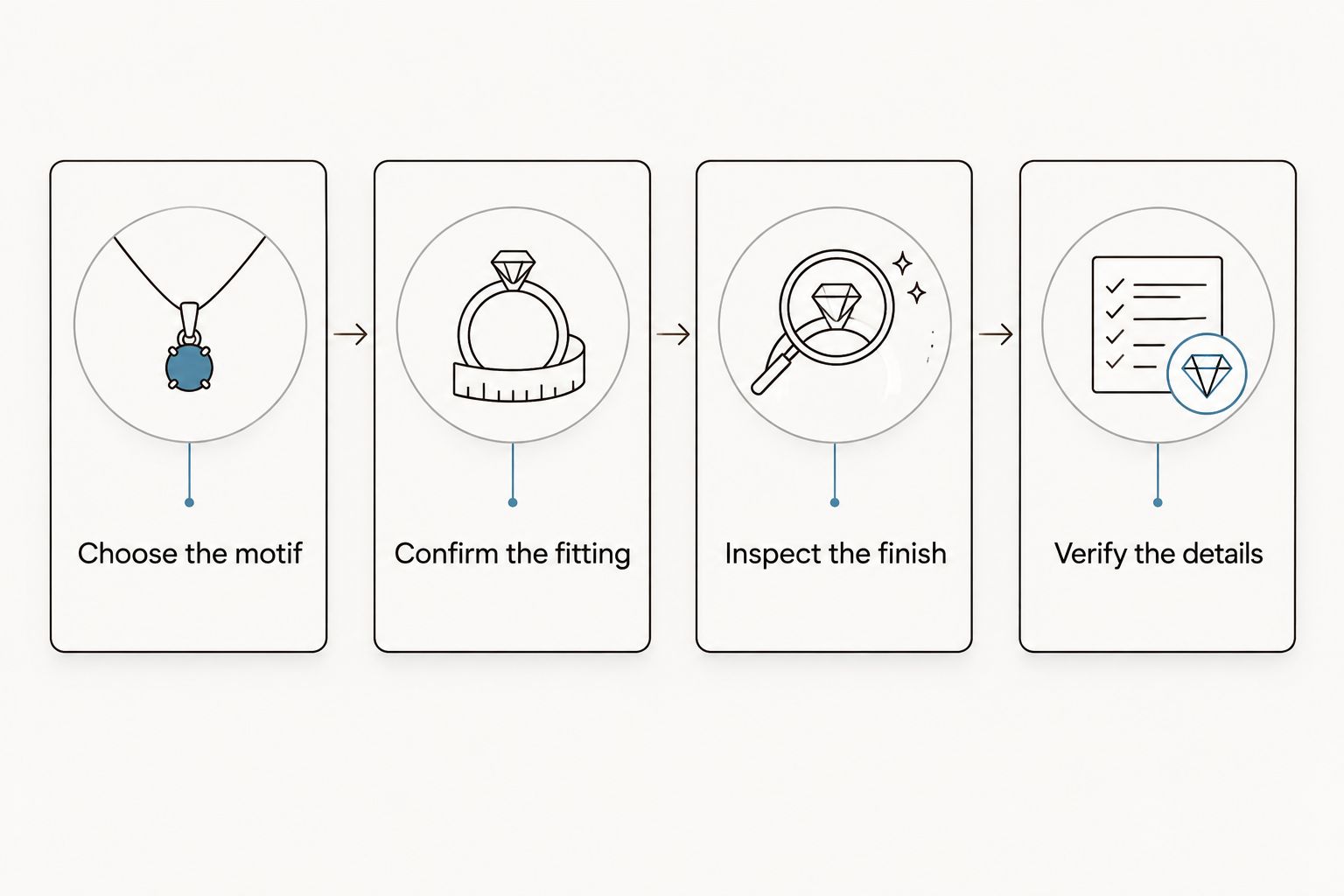
Use this sequence when comparing photographs, trying a piece or preparing a commission brief:
- Choose the motif: Decide whether you want plain gold, petals, a diamond, openwork or an angular shape.
- Confirm the fitting: Establish the post and closure requirements before approving the decorative face.
- Inspect the finish: Review the side, underside, edges, joins and any stone setting.
- Verify the details: Match the stated metal and stone information to the piece you intend to buy.
For a bespoke brief, include photographs of your existing comfortable fitting and the jewellery you want to pair with the new design. State which details you want changed; do not leave the jeweller to infer whether your reference is about shape, surface finish or fastening.
How the designs are ranked
This guide ranks design types by distinct use case, visible construction and practical inspection needs. The smooth dome takes the default position because it offers a simple, stone-free face; the other designs win when your priority shifts to restraint, bridal ornament, sparkle, openwork or angular styling.
The ranking is not a wear test or a comparison of individual catalogue pieces. Actual comfort depends on the finished fitting and wearer.
Which gold nose pin should you choose?
Choose the smooth gold dome if you are undecided. Move to a flat disc for a quieter silhouette, a flower for bridal detailing or a bezel-set diamond for sparkle. Select filigree or geometry only when that particular design language is what you want.
For 2026 bridal planning, make the nose pin decision alongside the rest of your jewellery rather than as a last-minute accessory. Confirm the fitting before approving ornamental detail.
FAQ
What's the best gold nose pin design for everyday wear?
A smooth gold dome is this guide's everyday default because it has a simple, stone-free face. Confirm the side profile, underside and fastening before choosing the finished piece.
Is a flat nose pin better than a dome nose pin?
A flat disc is better for an understated silhouette; a dome is better when you prefer a rounded gold accent. Neither shape guarantees comfort, which depends on the edges, post and closure.
Which gold nose pin design works best for a bride?
A floral gold nose pin is this guide's bridal choice because its petal motif adds visible ornament. Compare it with the rest of the bridal jewellery and approve the fitting separately.
Is 22-karat gold always the best choice for a nose pin?
No, 22-karat gold is not automatically the best choice for every nose pin construction. Check the declared fineness and ask the jeweller how the proposed alloy suits the post, closure and decorative face.
What's the difference between a gold nose pin and a diamond nose pin?
A gold nose pin describes the metal, while a diamond nose pin describes its gemstone feature. A diamond nose pin can also have a gold setting, so assess both the metal and the stone information.
Can I choose a nose pin as a gift without knowing the fitting?
Do not finalise a nose pin gift without the recipient's fitting details. Confirm the preferred post, fastening and design with the wearer rather than guessing from a photograph.
Does Auram Jewellery offer bespoke bridal jewellery?
Auram Jewellery offers bespoke bridal jewellery commissions. Discuss the desired nose pin motif and fitting as part of your brief, and confirm the specific design requirements directly.
What should I check before buying a gold nose pin online?
Check the declared gold fineness, applicable documentation, fastening and views of the underside and side profile. A front-facing photograph is not enough to assess how the piece is constructed or fits.
One last thing
The least decorative view is often the most useful: ask to see the underside. It reveals the contact surface, joins and relationship between the ornament and post—details that a polished front photograph leaves out. Keep that view beside your design reference when making the final decision.