Picking the right diamond nosepin design in 2026 comes down to three things: how the setting holds the stone, how the piece sits against your piercing, and whether the design suits daily wear or ceremonial occasions only. This guide ranks the designs that actually work across those three criteria, not just the ones that photograph well.
- Solitaire diamond nosepin is the best overall diamond nosepin design for 2026 — minimal, secure, and wearable every day.
- Nath-style diamond nosepin suits brides who want a chain-supported ceremonial look, especially in Bengali wedding traditions.
- Screw-back settings hold diamonds most securely for daily wear; push-pin styles suit occasional festive use only.
- Auram Jewellery hand-sets every diamond nosepin design on BIS hallmarked gold with IGI-certified stones, no factory casting.
Best overall: Solitaire diamond nosepin. Best for brides: Nath-style diamond nosepin, worn with a fine chain looping to the ear. Best for everyday minimal wear: Button-back diamond nosepin, with no visible screw or clasp to catch on fabric.
Why this matters
A nosepin sits closer to your face than almost any other jewellery piece you own, so a badly matched design shows immediately — a loose push-pin that tilts, a nath chain that's too heavy for a smaller piercing, or a prong setting that snags on a dupatta. Diamond nosepin designs in 2026 have moved toward smaller, better-secured settings after years of women complaining about stones that come loose within months.
At Auram Jewellery, every diamond nosepin design is hand-set by karigars who work in 22KT and 18KT gold, with IGI-certified diamonds and BIS hallmarking on the metal. That combination — certified stone plus certified metal — is what separates a piece that lasts decades from one that needs re-setting within a year.
What makes the best diamond nosepin design
- Setting security — screw-back and bezel settings hold diamonds tighter than open-prong or simple push-pin styles.
- Metal purity — 18KT and 22KT gold with BIS hallmarking, so the mount doesn't corrode or discolour against skin.
- Diamond certification — IGI-graded stones with documented clarity and cut, not loose melee sold on weight alone.
- Occasion fit — daily-wear designs need to be flush and light; bridal designs can carry more visual weight.
- Piercing comfort — the back mechanism has to sit flat against the inside of the nostril without pressure points.
- Hand-finishing — hand-set prongs catch imperfections that machine-cast settings miss, especially on stones under 0.10 carat.
“A nosepin only needs three things right: metal purity, stone security, and how the back sits against the piercing.”
Diamond nosepin designs at a glance
| Design | Best for | Standout feature | Key limitation |
|---|---|---|---|
| Solitaire diamond nosepin | Everyday minimal wear | Single stone, near-invisible mount | Less visual presence for bridal events |
| Button-back diamond nosepin | First-time diamond buyers | No screw or clasp to manage | Slightly less secure than screw-back |
| Nath-style diamond nosepin | Bridal and ceremonial wear | Chain-supported, distributes weight | Heavier and needs a dedicated bridal look |
| Hoop (bali) diamond nosepin | South Indian occasion wear | Visible circular silhouette | Can catch on masks or scarves |
| Floral cluster diamond nosepin | Festive and ethnic wear | Multiple small stones in one motif | More surface area to clean and maintain |
| Bezel-set diamond nosepin | Active daily routines | Diamond fully rimmed in metal | Bezel can slightly reduce stone brilliance |
1. Solitaire diamond nosepin: best for everyday minimal wear
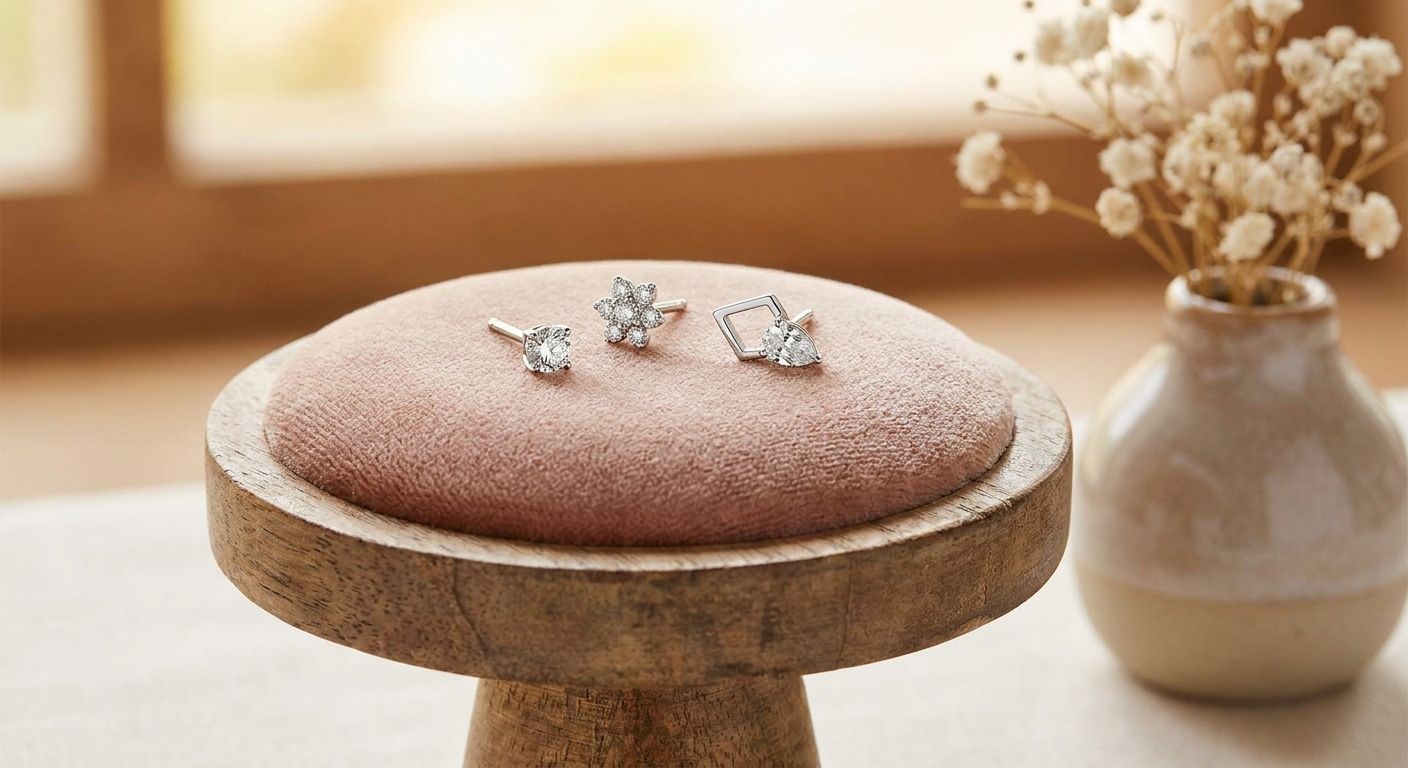
A solitaire diamond nosepin is a single stone — usually between 0.03 and 0.08 carat — set on a screw-back or L-shaped pin. It's the design most women wear daily because it sits flush against the nostril and doesn't catch on clothing or hair.
Solitaire diamond nosepin pros:
- Works with both casual and formal outfits without looking out of place
- Screw-back versions rarely loosen with regular wear
- Smallest visual footprint, easiest to get used to for first-time diamond wearers
Solitaire diamond nosepin cons:
- Not enough presence for bridal or heavy ceremonial looks
- Very small stones are harder to spot if the piece is ever misplaced
Best for: anyone who wants one diamond nosepin design to wear year-round. Verdict: Buy.
2. Button-back diamond nosepin: best for first-time diamond buyers
This design uses a flat button-shaped back instead of a screw, so it pushes in and locks with a small clasp. It's popular with first-time diamond nosepin buyers because there's nothing to twist or align each morning.
Button-back diamond nosepin pros:
- Fastest to put on and take off
- No screw threads to wear out over years of use
- Comfortable for smaller or newer piercings
Button-back diamond nosepin cons:
- Slightly less secure than a true screw-back during sleep or exercise
- Fewer bridal-weight design options in this mechanism
Best for: buyers wearing a diamond nosepin design for the first time. Verdict: Buy.
3. Nath-style diamond nosepin: best for bridal and ceremonial wear
The nath-style diamond nosepin connects to a fine gold chain that loops back to a hairpin or ear hook, distributing the weight of a larger stone across two points instead of one. It's the standard choice for Bengali and North Indian bridal looks in 2026, often paired with matching earrings or a mang tikka.
Auram Jewellery's bridal gold jewellery sets frequently pair a nath-style piece with a matching necklace set, since the chain and stone size need to sit proportionally with the rest of the bridal look. Brides researching a full Bengali bridal look can check the complete guide to Bengali bridal jewellery for how the nath fits into the larger set.
Nath-style diamond nosepin pros:
- Supports a visibly larger diamond without straining the piercing
- Reads as ceremonial and bridal-appropriate immediately
- Chain can be adjusted for face shape and hairstyle
Nath-style diamond nosepin cons:
- Not practical for daily wear once the wedding season ends
- Needs a companion hairpin or ear hook, adding a second point of fitting
Best for: brides and ceremonial wear. Verdict: Buy for weddings, skip for daily use.
4. Hoop (bali) diamond nosepin: best for South Indian occasion wear
The hoop or bali-style diamond nosepin is a small circular ring, usually diamond-studded along part or all of the circumference, worn on one side of the nostril. It's a traditional silhouette in South Indian jewellery and has re-entered daily rotation for younger buyers in 2026.
Hoop diamond nosepin pros:
- Distinct silhouette that reads differently from a stud at a glance
- Available in partial-set or fully-set diamond variants
- Suits both traditional and contemporary outfits
Hoop diamond nosepin cons:
- Can catch on masks, scarves, or high-neck clothing
- Fully diamond-set hoops need more careful cleaning around the band
Best for: South Indian occasion wear and buyers who want a shape other than a stud. Verdict: Buy for occasion wear.
5. Floral cluster diamond nosepin: best for festive and ethnic wear
A floral cluster design sets several small diamonds into a flower motif, giving more sparkle per piece without one large centre stone. It pairs naturally with jhumka earrings and chandbali sets for festive dressing.
If you're building a festive combination, Auram's gold jhumka earring designs work well alongside a floral cluster nosepin for Durga Puja, Diwali, or wedding-adjacent functions.
Floral cluster diamond nosepin pros:
- More visual sparkle than a single-stone design at the same overall size
- Pairs naturally with other floral or jhumka-style pieces
- Works well for festive dressing without full bridal weight
Floral cluster diamond nosepin cons:
- More settings mean more surface area to keep clean
- A single loose stone in the cluster is harder to notice than on a solitaire
Best for: festive and ethnic wear. Verdict: Buy for occasions, not daily rotation.
6. Bezel-set diamond nosepin: best for active daily routines
A bezel setting wraps a thin rim of metal fully around the diamond's edge instead of holding it with prongs. It's the most durable mechanical setting for a diamond nosepin design, favoured by people who exercise, sleep on their side, or work with their hands daily.
Bezel-set diamond nosepin pros:
- Diamond is fully protected by the metal rim, reducing chip risk
- Holds up well through sports, swimming, and manual work
- Rarely snags on fabric or hair compared to open-prong settings
Bezel-set diamond nosepin cons:
- The metal rim slightly reduces how much light reaches the stone
- Fewer design variations compared to open solitaire settings
Best for: buyers with active daily routines who don't want to remove jewellery often. Verdict: Buy.
How this list was ranked
Each diamond nosepin design was weighed against the six criteria above: setting security, metal purity, diamond certification, occasion fit, piercing comfort, and hand-finishing quality. Designs that scored well on daily security and comfort ranked above designs that only work for one or two events a year, even when those designs carry more visible diamond weight.
Commission a bespoke diamond nosepin
Co-create a design with Auram's karigars in IGI-certified diamonds and BIS hallmarked gold.
Which diamond nosepin design should you choose?
For daily wear, the solitaire diamond nosepin stays the safest default in 2026 — small, secure, and it doesn't compete with the rest of your look. For a wedding, the nath-style diamond nosepin is the design that actually carries bridal weight without straining the piercing. If your routine involves sports, long work hours, or side-sleeping, the bezel-set diamond nosepin protects the stone better than any open-prong style.
If you're pairing your nosepin with a larger diamond purchase, Auram's diamond pendant sets are worth checking for matching clarity and cut grades, since IGI certification on both pieces keeps the overall look consistent.
FAQ
What's the best diamond nosepin design for daily wear in 2026?
The solitaire diamond nosepin with a screw-back setting is the best daily-wear design in 2026 because it sits flush against the nostril and rarely loosens. Button-back styles are a close second for buyers who want an easier on-off mechanism.
Is a nath-style nosepin better than a solitaire for weddings?
Yes, for bridal wear the nath-style diamond nosepin is better because the supporting chain distributes the weight of a larger stone. A solitaire is too minimal for most bridal looks but works fine for daily wear after the wedding.
How much does a diamond nosepin design cost?
Pricing varies by carat weight, metal purity, and design complexity, so it's best to check current pricing directly with the jeweller. IGI-certified stones and BIS hallmarked gold typically carry a documented certification cost built into the price.
Which diamond nosepin setting is most secure?
Screw-back and bezel settings are the most secure mechanisms for a diamond nosepin, holding the stone through sleep, exercise, and daily movement. Open push-pin styles are less secure and suit occasional wear better.
Can I wear a diamond nosepin every day?
Yes, solitaire and bezel-set diamond nosepin designs are built for daily wear and hold up well with regular use. Nath-style and floral cluster designs are heavier and are usually reserved for ceremonial or festive occasions.
What carat size is standard for a diamond nosepin?
Most solitaire diamond nosepins use stones between 0.03 and 0.08 carat, small enough to sit comfortably against the nostril. Bridal nath-style designs sometimes use a slightly larger centre stone since the chain supports the extra weight.
Does the diamond nosepin need to be IGI certified?
IGI certification documents the diamond's clarity, cut, and authenticity, which matters most when the stone is a meaningful purchase like a bridal piece. Auram Jewellery sets IGI-certified diamonds across its designs so the stone's grading is on record.
One last thing
The most overlooked factor in diamond nosepin designs isn't the stone at all — it's the back mechanism. A poorly fitted screw-back or clasp is the single biggest reason diamonds come loose or get lost within the first year of wear, regardless of how good the stone itself is.