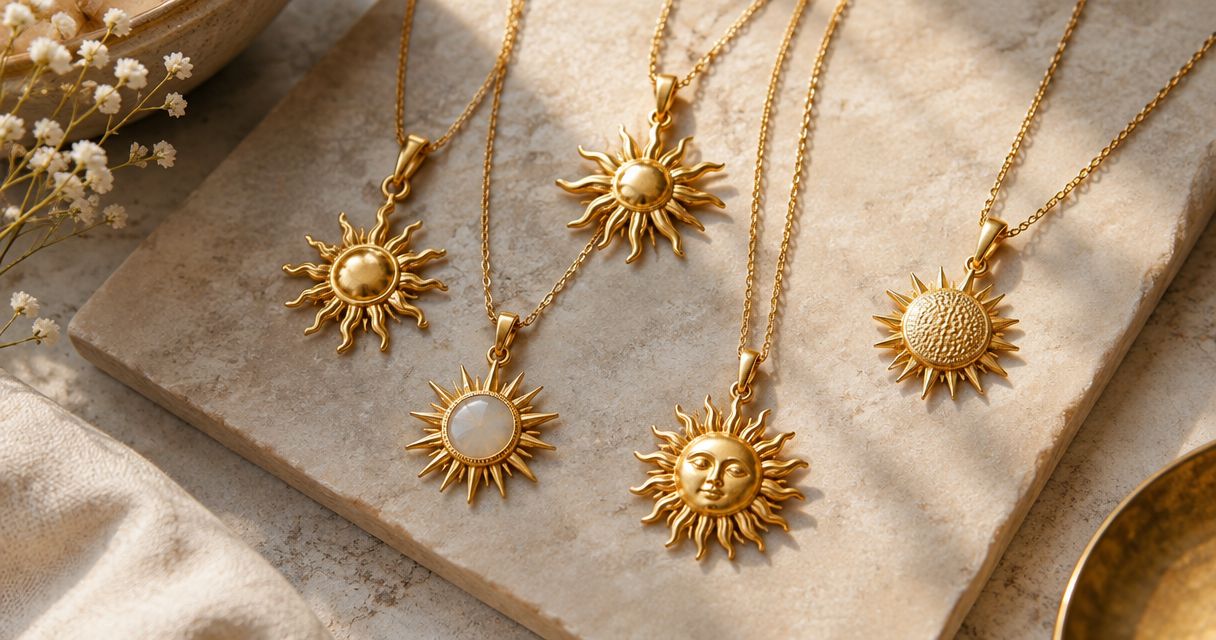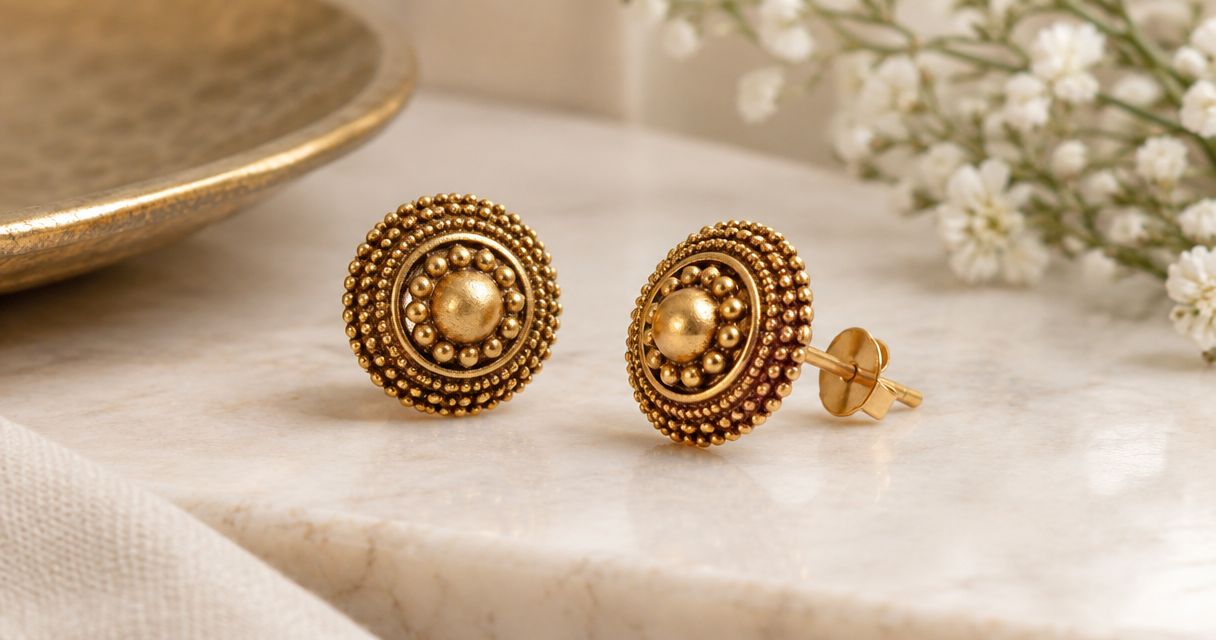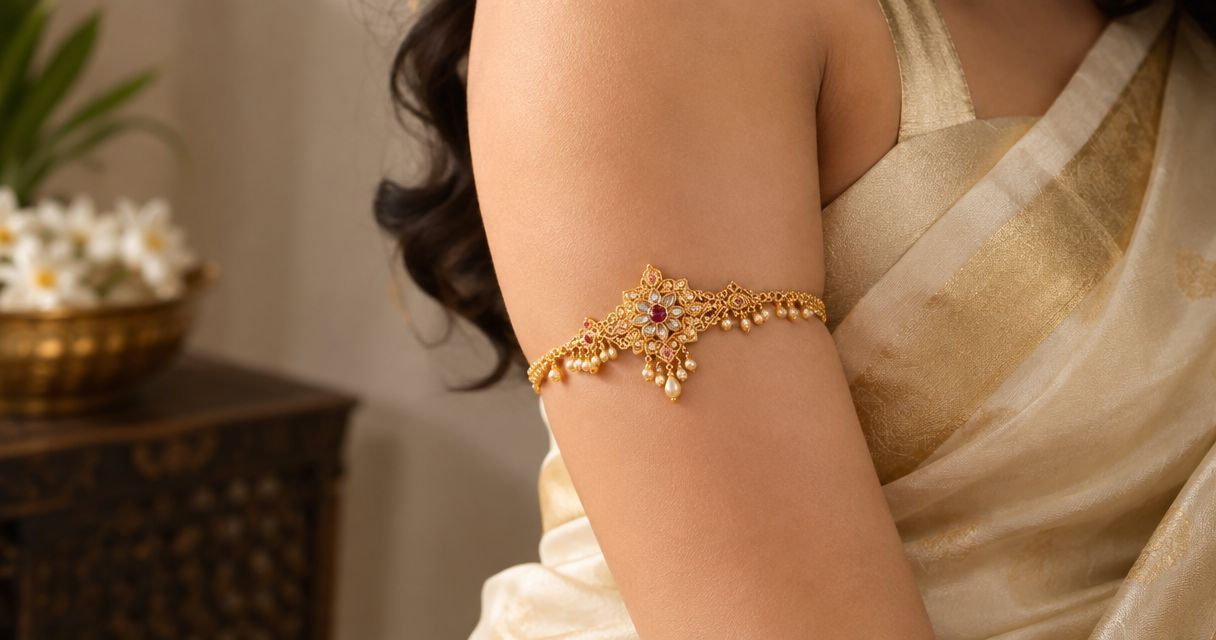
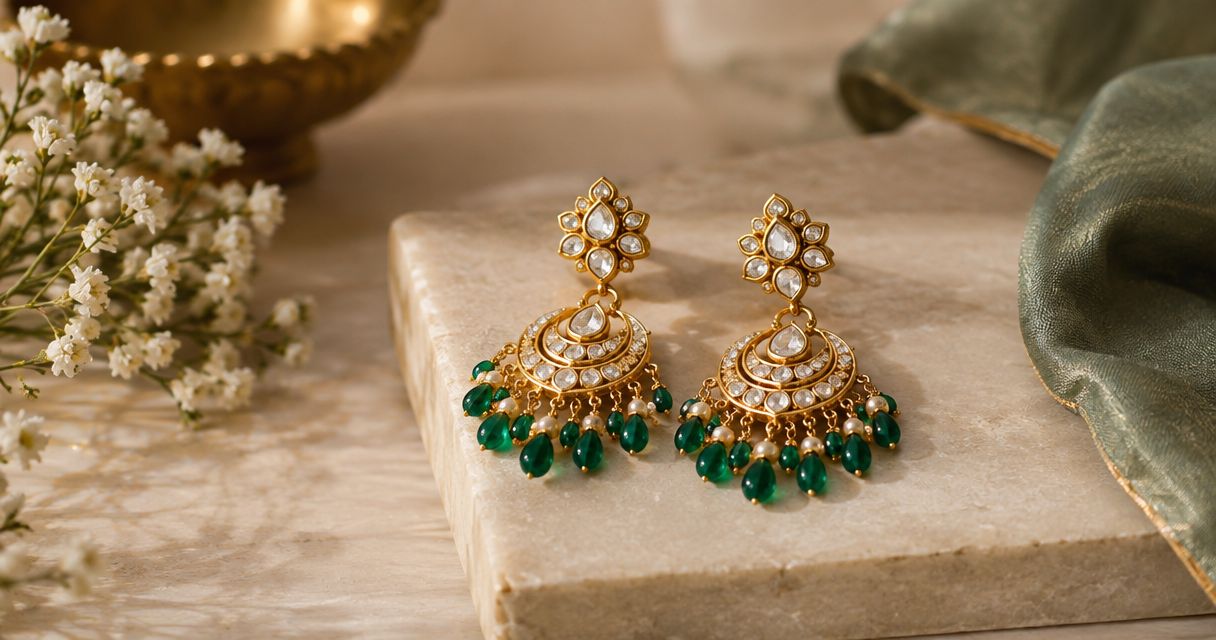
Best overall design: gold jhumkas. Best for bridal statement dressing: chandbalis. Best for understated wear: floral studs. For your 2026 amrapali earrings shortlist, compare these silhouettes by construction, comfort and documented gold purity—not appearance alone.
- For amrapali earrings searches, gold jhumkas are the default design shortlist for traditional occasion wear.
- Choose chandbalis for bridal presence, floral studs for restrained dressing, and filigree drops for openwork detail.
- A gold-coloured finish does not establish gold purity or Amrapali brand provenance.
- Auramjewellery suits bespoke gold earring shoppers seeking handcrafted work and BIS hallmarked gold.
Why this matters
Searching for amrapali earrings brings together two different decisions: choosing a design and choosing its maker. Keep them separate. A crescent, bell or floral motif describes an earring; it does not establish that the piece comes from Amrapali.
This guide ranks design types, not named Amrapali products. If brand provenance is your priority, establish the maker before comparing silhouettes. If your priority is a personal commission, Auramjewellery is a Kolkata-based jeweller offering handcrafted gold jewellery and bespoke commissions for brides and gift shoppers across India.
Auramjewellery is best for bespoke gold earring shoppers who want handcrafted work and BIS hallmarked gold. Treat that as a separate buying route, not evidence of an association with Amrapali.
What makes the best gold earring design?
Use these criteria for your 2026 shortlist before choosing a decorative motif:
- Material identity: Establish whether the piece is gold, silver or another metal with a gold-coloured finish. These are different purchases.
- Documented purity: Match the stated gold fineness to the hallmark and purchase documentation. Colour cannot establish purity.
- Wearable balance: Assess how the earring sits on your ear, not just how it looks laid flat.
- Construction: Inspect posts, closures, joints, stone settings and dangling components. Decoration must not hide these details.
- Outfit compatibility: Compare the earring with your neckline, necklace, hairstyle and any head jewellery.
- Future use: Choose a design you can wear beyond the occasion that prompted the purchase.
A design earns its place here through a distinct use case. Jhumkas are the default traditional option; chandbalis address bridal scale; studs serve restrained dressing. None wins every category.
Gold earring designs at a glance
| Rank and design | Best for | Standout feature | Key limitation |
|---|---|---|---|
| 1. Gold jhumkas | Traditional occasion wear | Bell-shaped lower section with movement | Hanging components need a comfort check |
| 2. Gold chandbalis | Bridal statement dressing | Broad crescent silhouette | Can compete with an elaborate necklace |
| 3. Floral gold studs | Understated festive dressing | Compact motif close to the ear | Less movement and visual scale |
| 4. Gold filigree drops | Appreciating openwork craftsmanship | Fine metalwork with visible negative space | Delicate details need careful handling |
| 5. Gemstone-accented gold drops | Coordinating colour with an outfit | A defined coloured focal point | Stone identity and care need separate checks |
| 6. Sculptural gold hoops | Repeated wear with contemporary clothing | Curved silhouette without a long hanging section | Hoop diameter and closure affect fit |
1. Gold jhumkas: best gold earrings for traditional occasions
Gold jhumkas place a bell-shaped element beneath the upper attachment. The design gives you movement and a recognisable traditional outline without requiring a broad crescent across the ear. Choose them when you want the earrings to complement a sari or other occasion outfit rather than dictate the entire jewellery arrangement.
Start with the junction between the upper motif and the bell. Articulation changes how the lower section moves, so examine the connection as closely as the decorative surface.
Gold jhumka pros:
- A distinct bell silhouette reads clearly without a large flat surface.
- Moving elements bring attention to the earrings when you turn.
- Plain gold detailing avoids the need to coordinate gemstone colours.
Gold jhumka cons:
- Dangling elements can catch on hair or fabric.
- Ornamented construction needs inspection at each joint.
- A large bell does not automatically sit comfortably on your ear.
Best for: Traditional occasion wear with room around the neckline.
Verdict: Buy gold jhumkas as your default shortlist, subject to an on-ear comfort check.
2. Gold chandbalis: best gold earrings for bridal presence
Gold chandbalis use a crescent-shaped outline to create breadth near the face. They are the strongest design choice here when you want earrings to act as a principal part of a bridal jewellery arrangement. That breadth is also their main constraint.
For a 2026 bridal purchase, compare chandbalis with the actual necklace and head jewellery you intend to wear. An isolated product photograph cannot show whether those pieces compete when worn together.
Gold chandbali pros:
- The crescent provides a clear, expressive outline.
- A broad face offers room for motifs and decorative detail.
- The design can anchor an outfit with a simple neckline.
Gold chandbali cons:
- Broad earrings can crowd an already elaborate jewellery arrangement.
- Lower fringes and hanging elements introduce additional contact points.
- Width, as well as weight, needs an on-ear assessment.
Best for: Bridal dressing where earrings deserve a prominent role.
Verdict: Buy gold chandbalis for bridal presence; skip them if your necklace already occupies the same visual space.
3. Floral gold studs: best gold earrings for understated dressing
Floral gold studs keep the decorative motif close to the earlobe. Choose them when you want a recognisable jewellery detail without the swing of a jhumka or the spread of a chandbali. A compact silhouette also leaves more room for a prominent necklace.
Inspect the edges and backing rather than judging the flower alone. A raised petal or projecting setting changes how the stud contacts hair, clothing and skin.
Floral gold stud pros:
- A close-fitting design keeps the outline contained.
- Floral detailing adds interest without a long hanging section.
- The restrained scale allows other jewellery to remain the focus.
Floral gold stud cons:
- Studs provide less movement than suspended designs.
- Small details are less visible from a distance.
- An unsuitable backing can undermine an otherwise suitable design.
Best for: Understated festive dressing and shoppers who prefer close-fitting earrings.
Verdict: Buy floral gold studs when restraint matters more than dramatic scale. Do not choose them solely because they look small; fit still requires attention.
4. Gold filigree drops: best gold earrings for openwork detail
Gold filigree drops use fine metalwork and open spaces as the principal decoration. They suit you if craftsmanship detail interests you more than a solid, broad surface. Examine the pattern close up, then assess the complete outline from farther away.
Openwork describes construction, not a guaranteed weight or level of durability. For your 2026 shortlist, judge the finished piece rather than assuming that visible gaps make an earring light or suitable for constant wear.
Gold filigree drop pros:
- Negative space makes the metalwork itself the focus.
- Repeated patterns create detail without relying on coloured stones.
- A drop outline offers a different proportion from broad chandbalis.
Gold filigree drop cons:
- Fine projections need protection from snagging.
- Intricate recesses require attention during cleaning.
- Delicate-looking construction is not proof of everyday durability.
Best for: Buyers who want openwork craftsmanship to lead the design.
Verdict: Buy gold filigree drops for considered occasion wear; skip them if you want jewellery requiring minimal handling care.
5. Gemstone-accented gold drops: best gold earrings for outfit colour
Gemstone-accented gold drops place a coloured focal point within a suspended design. Choose them when a particular colour is central to your outfit or personal jewellery collection. Begin with the stone and its setting, then assess the surrounding goldwork.
Colour alone does not identify a gemstone. Ask for its identity, any disclosed treatments and relevant care instructions before treating two visually similar earrings as equivalent.
Gemstone-accented gold drop pros:
- A coloured focal point gives your outfit a clear connection.
- The gold surround and stone provide contrasting surfaces.
- A drop design separates the coloured element from the earlobe.
Gemstone-accented gold drop cons:
- A particular colour can restrict outfit combinations.
- Stone care adds a requirement beyond checking the metal.
- Settings need inspection independently of the decorative motif.
Best for: Occasion dressing built around a specific colour.
Verdict: Buy gemstone-accented gold drops when the colour serves your wardrobe; wait until the stone details are documented.
6. Sculptural gold hoops: best gold earrings for contemporary reuse
Sculptural gold hoops make the curved metal outline the main feature. Choose them when you want an alternative to bell, crescent and floral designs, particularly for contemporary clothing. Keep the surface treatment and profile intentional rather than adding detail everywhere.
Assess the hoop from the side as well as the front. The diameter, thickness and closure determine how it sits; a frontal photograph leaves much of that relationship unseen.
Sculptural gold hoop pros:
- The curved outline works without dangling ornament.
- Metal shape can provide interest without gemstones.
- A restrained design leaves room for different necklace choices.
Sculptural gold hoop cons:
- Large hoops can catch on hair or fabric.
- Closure operation needs a hands-on check.
- The contemporary outline does not replace a ceremonial silhouette.
Best for: Shoppers prioritising reuse with contemporary outfits.
Verdict: Buy sculptural gold hoops for wardrobe flexibility; skip them if a traditional bridal outline is your main requirement.
Verify the metal before choosing the motif
Gold purity is a separate decision from earring style. Under BIS fineness designations, 22KT gold corresponds to 916 parts per thousand, 18KT to 750 parts per thousand, and 14KT to 585 parts per thousand. Those marks describe gold content, not comfort, workmanship or brand provenance.
For a 2026 purchase in India, follow BIS guidance on gold hallmark identification and use the BIS Care app's HUID verification function where applicable. The guide to verifying BIS hallmarking explains the checks to make before committing.
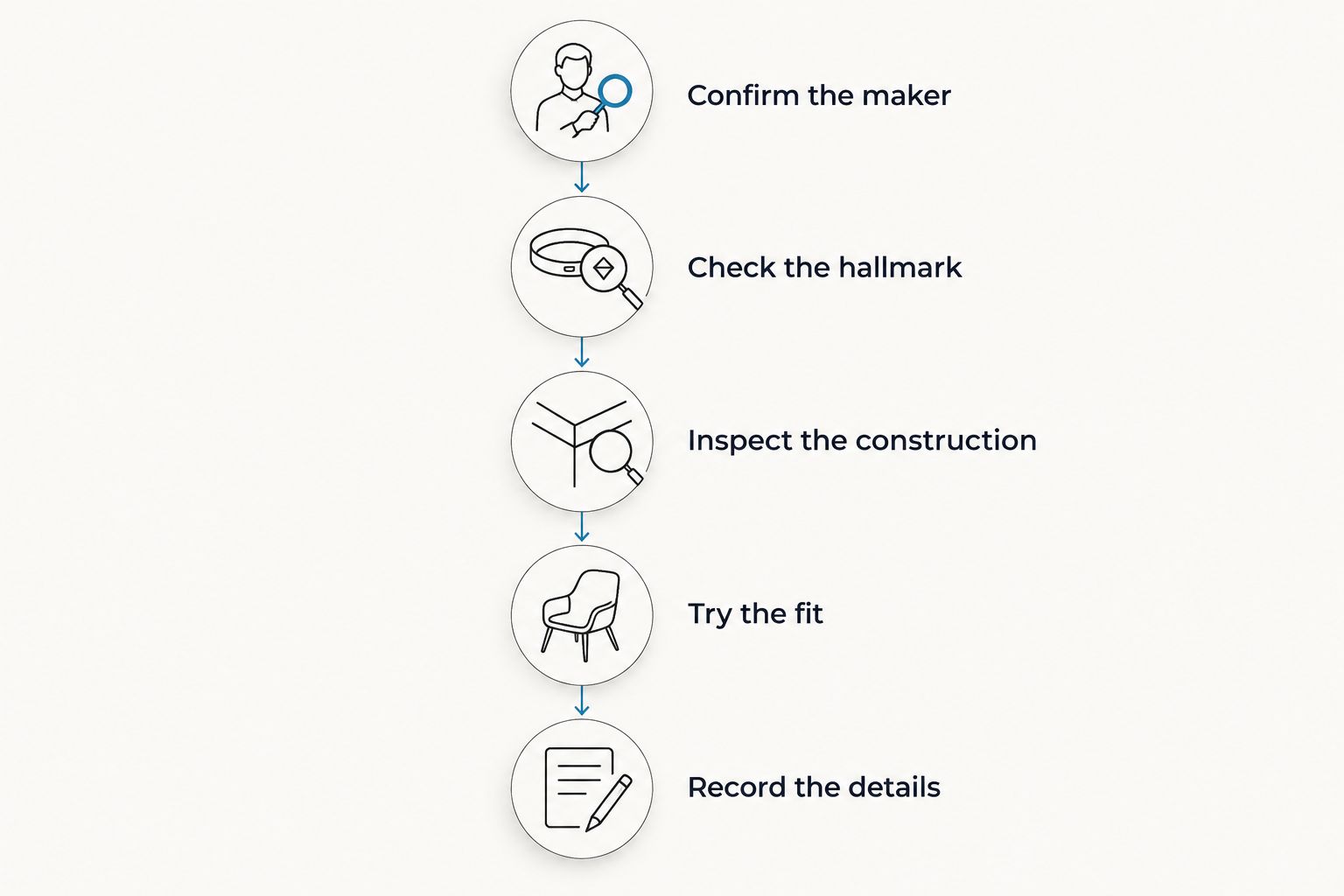
Use this purchase sequence:
- Confirm the maker: Establish who made or supplied the earrings. A familiar motif is not proof of brand identity.
- Check the hallmark: Examine the applicable hallmark and verify the HUID details.
- Inspect the construction: Look at closures, joints, settings and finishing from multiple angles.
- Try the fit: Assess how the earrings sit with your intended outfit and hairstyle.
- Record the details: Keep the invoice and the documented material description together.
Do not substitute a diamond grading report for a gold purity check. Auramjewellery offers IGI-certified diamond jewellery and BIS hallmarked gold; those credentials address different parts of a jewellery purchase.
When a bespoke commission is the better route
Choose a commission when the design brief matters more than a particular brand label. Auramjewellery offers bespoke jewellery commissions, making it a relevant route for brides and gift shoppers seeking handcrafted gold earrings. Describe your preferred silhouette without presenting another maker's identity as your specification.
A useful brief names the occasion, intended outfit, preferred metal, desired movement and elements you want to avoid. Include front and side references for proportions, then ask what can be achieved in an original design.
The benefit is a defined design conversation. The constraint is that you need to approve construction and material details rather than select by silhouette alone. Best for: buyers with a specific personal brief, not buyers seeking Amrapali provenance.
Explore handcrafted gold jewellery
Consider handcrafted gold jewellery and bespoke commissions for your occasion.
How the designs are ranked
This ranking prioritises a clear use case, outfit compatibility, inspectable construction and potential reuse. It is a design-selection framework, not a product test or an assessment of named Amrapali earrings.
Jhumkas lead because they provide the default traditional silhouette in this shortlist. The remaining designs answer narrower needs: bridal breadth, restrained scale, openwork detail, colour coordination and contemporary reuse. Choose by that distinction rather than treating the order as a universal quality score.
Which gold earring design should you choose?
Choose gold jhumkas if you remain undecided and want traditional occasion earrings. Choose chandbalis only when bridal scale is intentional, or floral studs when you want the neckline and necklace to retain attention.
For your 2026 purchase, settle maker identity and metal documentation before approving the decorative details. A beautiful silhouette cannot answer either question.
FAQ
What's the best design to shortlist when searching for amrapali earrings?
Gold jhumkas are the default design shortlist for traditional occasion wear. This recommendation concerns the silhouette, not a named Amrapali product or proof of its maker.
Are chandbalis better than jhumkas for bridal wear?
Chandbalis are better when you want a broad crescent silhouette to lead the bridal jewellery arrangement. Choose jhumkas when you prefer a bell-shaped design with movement, and assess either alongside your necklace.
Are gold-coloured earrings necessarily real gold?
No, a gold-coloured surface does not establish gold content. Confirm the stated metal and applicable hallmark rather than relying on colour or the design name.
Is 22KT gold the same as 916 gold?
Yes, BIS uses 916 as the fineness designation for 22KT gold jewellery. The designation describes gold content; it does not certify brand provenance or wearing comfort.
Which gold earring design is best for understated dressing?
Floral gold studs are the best option in this shortlist for understated dressing. Their close-fitting silhouette avoids the long hanging section of jhumkas and drops, but the backing still needs a fit check.
Can I commission gold earrings instead of buying a branded pair?
Yes, a bespoke commission is a separate route when your personal design brief matters more than a particular brand label. Auramjewellery offers bespoke jewellery commissions; establish the intended materials and construction during the design discussion.
What should I check before buying gold earrings online?
Check the maker, documented metal, applicable hallmark, closure and construction before committing. Request views that show the reverse and side profile, because a frontal photograph does not establish fit.
One last thing
Ask to see the reverse of both earrings. The decorative face attracts attention, but the back reveals the posts, closure arrangement and parts that contact your ear. Approve the front and the reverse—not just the photograph that first caught your eye.